Trump Calls Google CEO Sundar Pichai a 'Monster' — And He Meant It as Praise
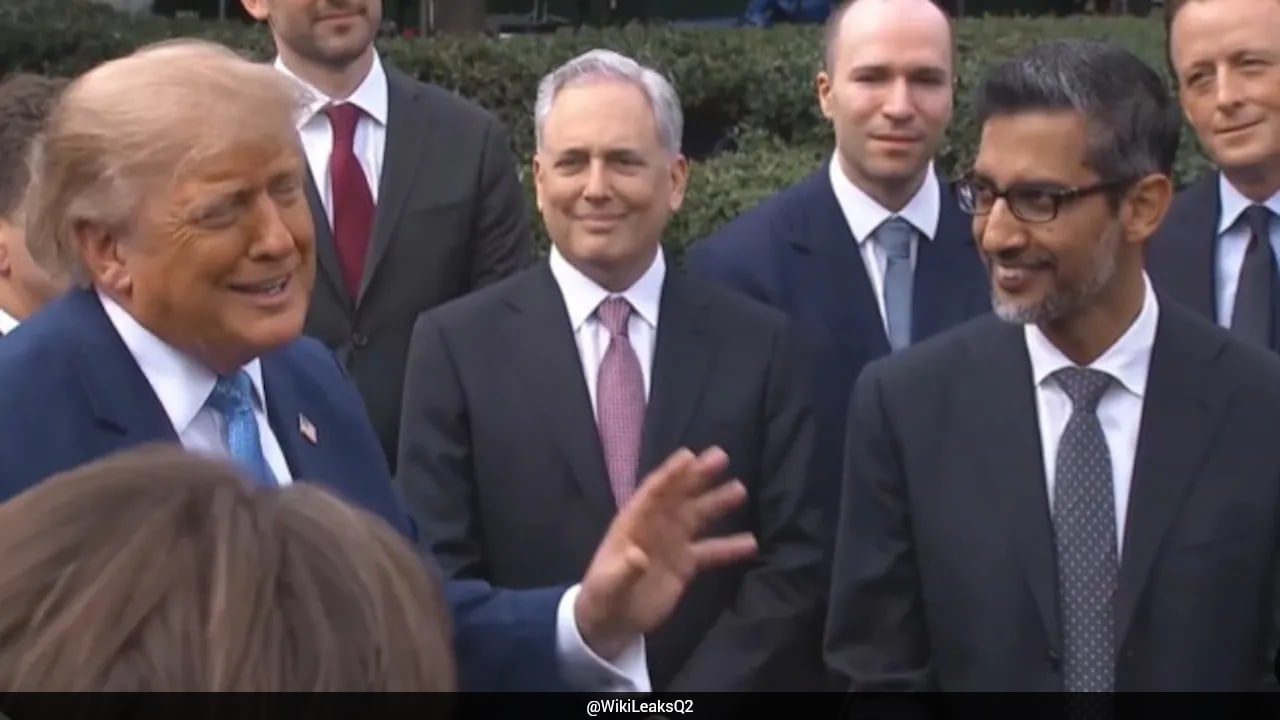
United States President Donald Trump on Tuesday described Google chief executive Sundar Pichai as a "monster", a remark he immediately cast as praise, while hosting leading artificial intelligence executives at the White House.
Introducing Pichai to reporters outside the West Wing, Trump said: "This guy is a monster, and nobody knows." The US President used the word to underline Pichai's influence and success in the technology industry rather than as criticism.
The meeting brought together Pichai, Meta chief executive Mark Zuckerberg and Anthropic chief executive Dario Amodei, among others, to discuss a voluntary agreement on AI safety and oversight.
According to those present, the framework is aimed at strengthening oversight of advanced AI systems through a combination of internal and external reviews.
Explaining the arrangement, Pichai said the companies were adopting established corporate governance practices for AI development.
"We are signing up to a set of processes and controls as we do in other areas, like financial controls, in a company. And we are bringing those well-known best practices to the development of superintelligence," Pichai told reporters.
Zuckerberg said the accord included "a set of principles and commitments around building robust internal controls and detecting if there are any issues with the technology".
He added that it would involve multiple layers of oversight, including internal risk reviews, external auditing and independent reviews by company boards.
Amodei, whose company Anthropic has frequently highlighted the potential risks posed by advanced AI systems, said the industry could improve safety standards but acknowledged that challenges remain.
"But I think the technology has very real risks. And, you know, the mechanism, how we address those risks is still under discussion," he said. Amodei, who had dinner with Trump on Sunday, also attended Tuesday's meeting.
Trump later said AI companies had agreed to strengthen oversight of the technology through voluntary commitments.
"I think I'm seeing tremendous self-policing. And they understand that they have to self-police," he told reporters outside the West Wing.
Details of the agreement were not immediately released.
The meeting came as the Trump administration has spent months defending the expansion of AI infrastructure, including the construction of data centres across the United States, amid criticism from both supporters and opponents of the buildout.
Speaking outside the White House, Trump argued that data centres can benefit local communities.
"By the way, I'm very good at real estate. Some of those buildings are absolutely beautiful," he said. "They're big, and they're, you know, big, strong, powerful buildings. But they're beautiful, and they add greatly to a community."
The push for voluntary commitments reflects a wider debate over how artificial intelligence should be governed. Supporters of voluntary standards argue that they let innovation continue while companies adopt safeguards quickly; critics contend that binding rules and independent regulators are needed to hold firms accountable.
The companies involved have not said which specific safeguards they will adopt, how compliance will be measured, or what consequences firms would face for falling short. It is also not clear whether the commitments will be reviewed by any government agency.
Trump has repeatedly defended the expansion of AI infrastructure in the US, arguing that the country needs to lead on the technology, including in areas such as data centres and energy supply.







