Supreme Court gets three new judges; women now three of 37
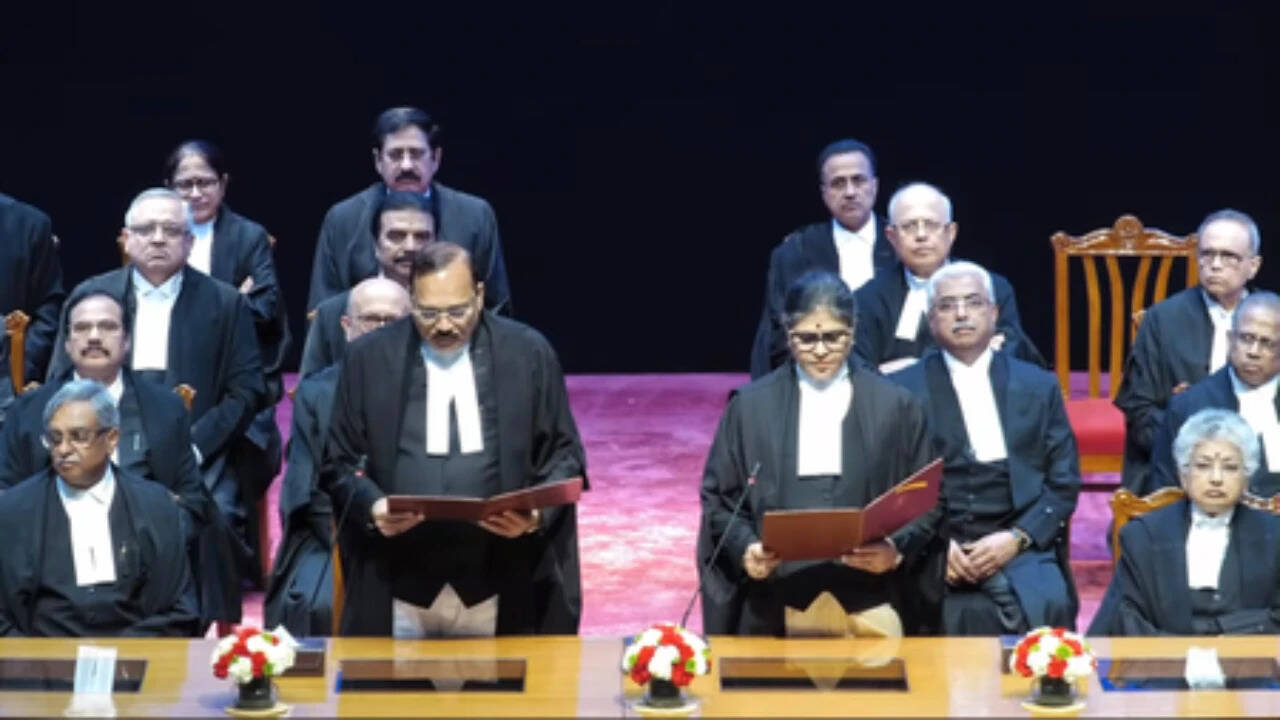
Three new judges took oath of office at the Supreme Court on Tuesday, taking the working strength of the apex court to 37, one short of its sanctioned strength of 38. Chief Justice of India Surya Kant administered the oath to Justices Sunita Agarwal, Devendra Kumar Upadhyaya and Aparesh Kumar Singh.
The three judges took the oath in the name of God. The ceremony was held in the presence of sitting judges of the Supreme Court, Attorney General R Venkataramani, Solicitor General Tushar Mehta, and other senior advocates and lawyers.
Before their elevation, Justice Agarwal was Chief Justice of the Gujarat High Court, Justice Upadhyaya was Chief Justice of the Delhi High Court, and Justice Singh was Chief Justice of the Telangana High Court.
With Justice Agarwal's appointment, the number of women judges in the Supreme Court is now three. She is the 13th woman to serve as a judge of the apex court. The other two women judges currently sitting are Justice B V Nagarathna, who is scheduled to become the first woman Chief Justice of India on September 24 next year, and Justice V Mohana.
The highest number of women judges sitting together in the Supreme Court so far has been four, during the tenure of Justice N V Ramana as Chief Justice of India. They were Justices Indira Banerjee, Nagarathna, Hima Kohli and Bela M Trivedi, the last three of whom took oath on August 31, 2021. The Collegium headed by Justice Ramana had recommended the appointment of three women judges. The present Collegium, led by Chief Justice Kant, has so far appointed two women judges.
Justice M Fathima Beevi became the first woman judge of the Supreme Court on October 6, 1989 — 39 years after the court was established. She had retired from the Kerala High Court on April 29, 1989, and was elevated to the Supreme Court five months after her retirement.
Other women who have served as judges of the Supreme Court include Justices Sujata V Manohar, Ruma Pal, Gyan Sudha Misra, Ranjana P Desai, R Bhanumathi and Indu Malhotra.
The sanctioned strength of the Supreme Court was raised from 34 to 38, including the Chief Justice of India, initially through an Ordinance on May 16. The corresponding Amendment Act was passed by Parliament and received the President's assent on August 11.
In August 2019, during the tenure of Chief Justice Ranjan Gogoi, the sanctioned strength was increased from 31 to 34, including the Chief Justice of India.
The Supreme Court began functioning in 1950 with a sanctioned strength of eight judges. This was raised to 11 in 1956, 14 in 1960, 18 in 1978, 26 in 1986 and 31 in 2009.
The court had a pendency of 95,481 cases as of Tuesday, according to the figures cited at the time of the swearing-in.







