Rajnath Singh Pledges 'Unwavering Commitment' to ASEAN, Calls for Stronger Defence Ties
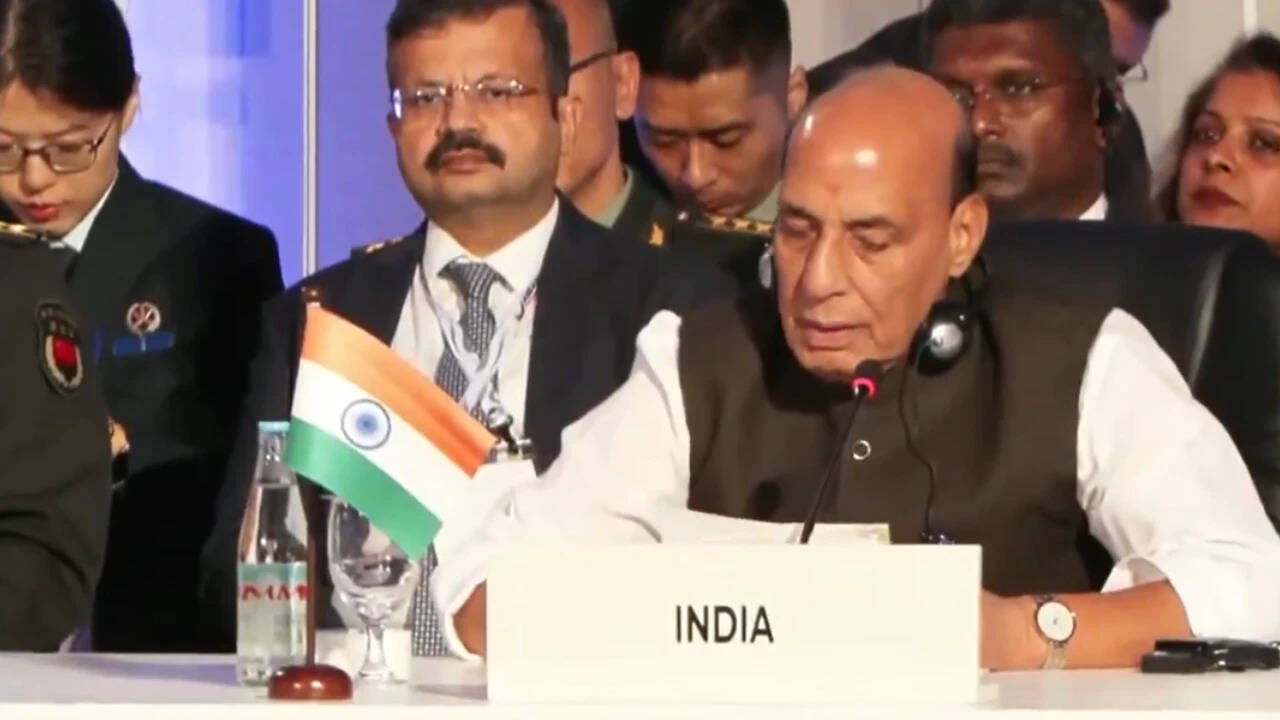
Defence Minister Rajnath Singh has reaffirmed India's "unwavering commitment" to ASEAN centrality in the Indo-Pacific and called for stronger defence and security cooperation with the ten-nation grouping at the ASEAN Defence Ministers' Meeting-Plus (ADMM-Plus) hosted by Malaysia.
Addressing his counterparts from the bloc and its dialogue partners, Mr Singh said India regards ASEAN as central to the region's security architecture and supports the grouping's own mechanisms for dialogue, confidence-building and the peaceful settlement of disputes. India, he said, wants the association to remain the driving force behind regional institutions rather than being sidelined by competing arrangements.
The ADMM-Plus brings together the ten ASEAN members — Brunei, Cambodia, Indonesia, Laos, Malaysia, Myanmar, the Philippines, Singapore, Thailand and Vietnam — with eight dialogue partners: Australia, China, India, Japan, New Zealand, the Republic of Korea, Russia and the United States. It is the region's principal forum for practical defence cooperation.
"ASEAN centrality" is the principle that the grouping should remain the organising hub of Asia-Pacific diplomacy, including forums such as the East Asia Summit and the ADMM-Plus. India has backed this principle consistently since becoming a full ASEAN dialogue partner in 1992, with summit-level engagement beginning in 2002 and the relationship elevated to a Comprehensive Strategic Partnership in 2022.
Mr Singh's remarks build on India's Act East Policy, under which New Delhi has steadily expanded its defence footprint in Southeast Asia. India and ASEAN already cooperate through the ADMM-Plus expert working groups on maritime security, counter-terrorism, humanitarian assistance and disaster relief, peacekeeping operations, military medicine, cyber security and humanitarian mine action. The two sides have also held the ASEAN-India Maritime Exercise (AIME), whose first edition took place in 2023, alongside regular naval deployments, port calls and joint training programmes.
The defence minister is understood to have underlined the importance of freedom of navigation and overflight, unimpeded lawful commerce and the peaceful resolution of disputes in the Indo-Pacific in accordance with international law, including the United Nations Convention on the Law of the Sea (UNCLOS), 1982. This has been India's stated position in successive joint statements with ASEAN and its member states.
The meeting comes amid continuing tensions in the South China Sea, where overlapping claims have led to repeated confrontations at sea, and as ASEAN works towards a long-delayed Code of Conduct with China. India is not a party to the disputes but has consistently argued that they must be settled peacefully and without coercion, and that the region's sea lanes — critical to global trade and to India's own energy supplies — must remain open.
India's ties with individual ASEAN members have deepened in parallel. New Delhi elevated its relationship with Malaysia to a Comprehensive Strategic Partnership in 2024, and maintains close defence ties with Vietnam, the Philippines, Singapore and Indonesia through training, equipment supply and maritime domain awareness cooperation. New Delhi has also pitched its Indo-Pacific Oceans Initiative, launched in 2019, as a cooperative framework open to all regional partners.
Analysts note that India walks a careful line in the region: it seeks deeper security engagement with Southeast Asian states and with like-minded partners, while avoiding the appearance of joining any bloc directed against China. Mr Singh's emphasis on ASEAN-led structures rather than alternative groupings fits that approach.
Officials said India would continue to press for concrete outcomes in the ADMM-Plus working groups, including joint exercises, capacity-building for smaller member states and faster coordination during natural disasters — a priority for a region frequently hit by cyclones, earthquakes and tsunamis.