Rahul Gandhi Hits Out at RSS: 'No One Can Claim to Know the Truth for Another'
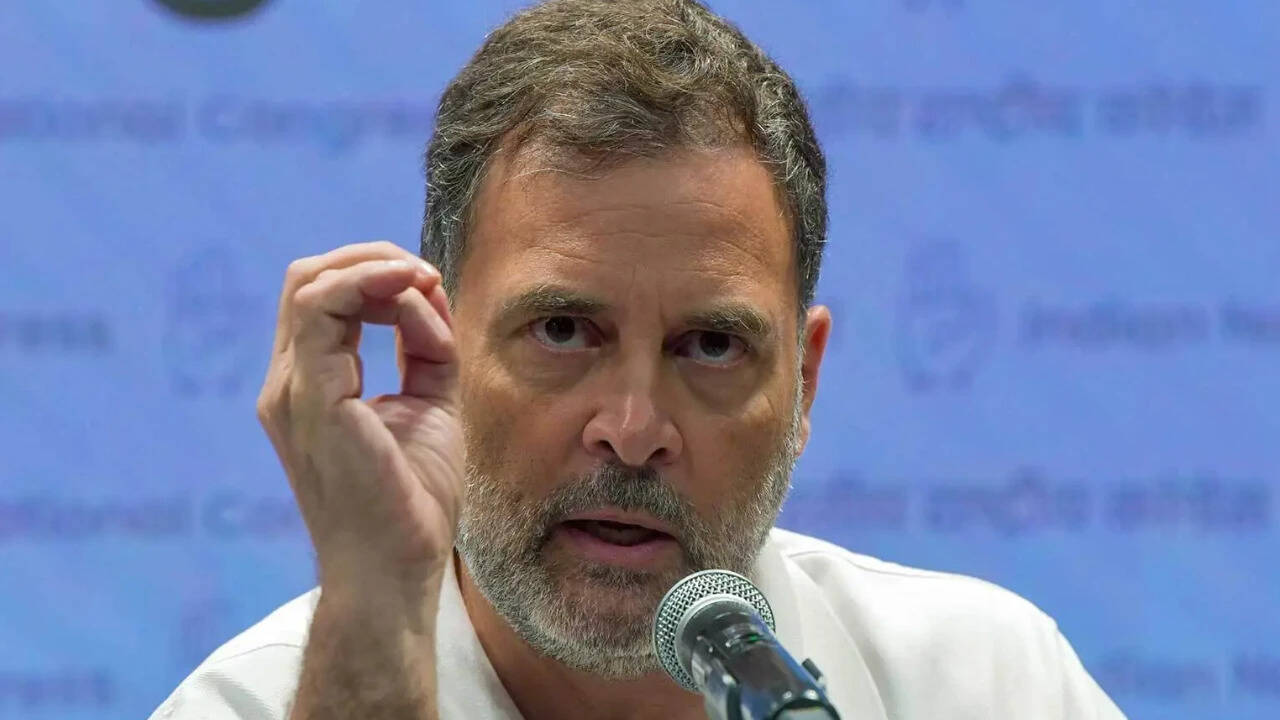
Congress leader Rahul Gandhi on Friday said the Rashtriya Swayamsevak Sangh (RSS) believes it knows the truth for everyone, asserting that no organisation or individual can claim to understand what is true for another person. He made the remarks while speaking at the ‘Hara Bhara Swaraj: A Tribute to Rajiv Gandhi’s Vision’ programme in New Delhi.
Drawing a sharp contrast between the RSS worldview and Mahatma Gandhi’s idea of ‘Swaraj’, the Congress leader described the ideological contest in India as a deeper struggle over how people understand themselves, freedom and their place in society. “The RSS believes it knows the truth for everyone. But Swaraj, as Mahatma Gandhi envisioned it, rests on the belief that every individual has the right to discover their own truth,” he said.
Gandhi’s remarks come amid an ongoing political debate over the role of the RSS in shaping India’s social and political fabric. The RSS, founded in 1925, has long advocated a unified Hindu identity as the bedrock of Indian nationhood. Its ideological wing, the Sangh Parivar, includes political parties and cultural organisations that influence public discourse. However, critics have often accused the RSS of promoting a majoritarian agenda that undermines India’s pluralistic traditions.
The Congress leader did not name any specific policy or action of the RSS in his speech, but linked the Sangh’s philosophy to a centralising tendency. “When any institution claims a monopoly over truth, it inevitably curtails the freedom of the individual. This is the fundamental difference between the RSS’s vision and the vision of those who fought for India’s independence,” he added.
The event was organised to commemorate the 80th birth anniversary of former Prime Minister Rajiv Gandhi, who was assassinated in 1991. Speaking on the occasion, Rahul Gandhi invoked the legacy of his father and grandfather, Jawaharlal Nehru, to stress the importance of democratic institutions and open debate. He urged party workers to engage with people at the grassroots level to counter what he called “attempts to centralise power and thought”.
Political analysts say the remarks are part of a broader Congress strategy to position itself as the defender of constitutional values and individual liberties against what it describes as the RSS’s cultural nationalism. The BJP, which shares ideological roots with the RSS, has often dismissed such criticisms as attempts to distract from governance issues.
Neither the RSS nor the BJP had issued an official response to Gandhi’s comments at the time of writing. However, RSS leaders have in the past defended their philosophy as a unifying force that transcends party politics.
The debate over the RSS’s ideology is not new. Since Independence, Indian political discourse has oscillated between the secular, pluralist vision of the Congress and the cultural nationalist outlook of the Sangh. Religious leaders, social reformers and constitutional experts have also weighed in at various times. The Gandhi family’s critique is rooted in a historical rivalry that dates back to the assassination of Mahatma Gandhi, who was killed by Nathuram Godse, a former RSS volunteer, in 1948. The RSS has repeatedly denied any institutional connection to the killing.
In his speech, Rahul Gandhi also called for a revival of the idea of ‘swaraj’ as an antidote to what he called “the politics of fear and division”. He said that true freedom comes from empowering communities and individuals, not from imposing a single worldview. “Our fight is not just political; it is ideological. We must reclaim the idea of India as a country where every voice matters,” he said.
The programme was attended by Congress workers and leaders from across the country. Several speakers praised Rajiv Gandhi’s contributions to modernising India, including his initiatives in technology, education and local governance. Rahul Gandhi’s remarks were met with applause from the audience, but they also highlight the deep ideological chasm that continues to shape Indian politics.







