PM Modi Commutes by Delhi Metro to SRCC, Engages with Students
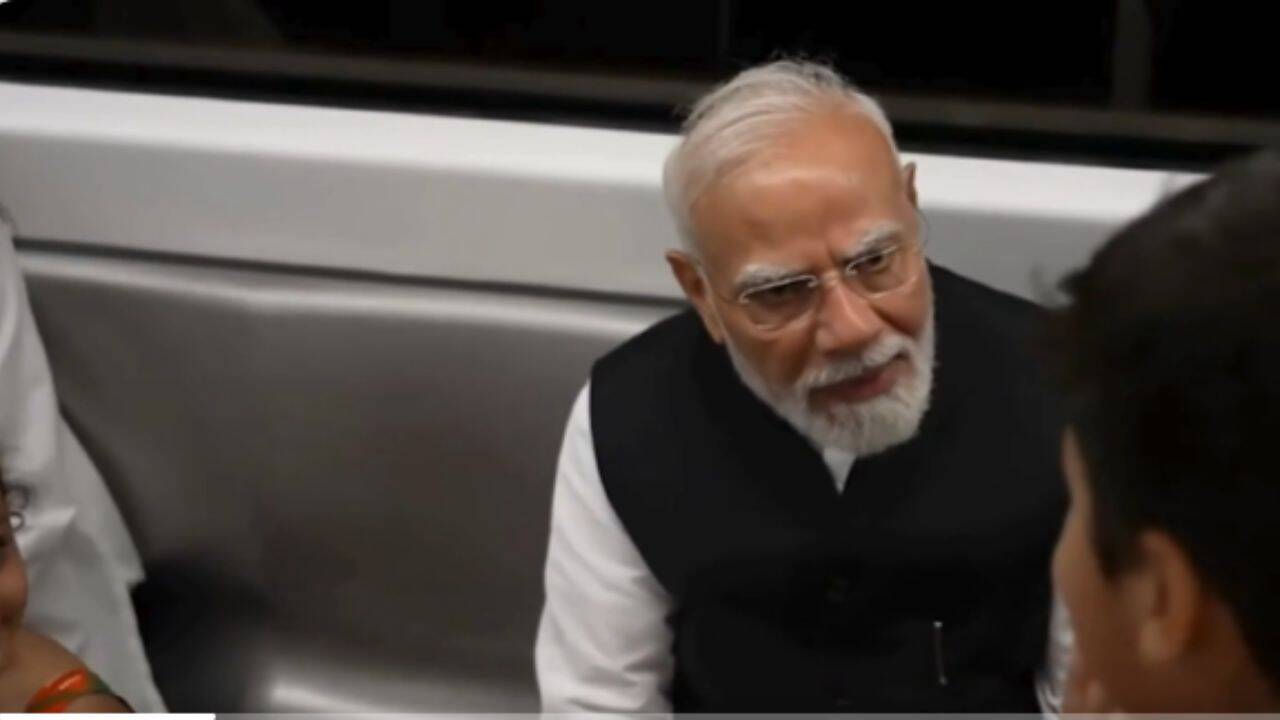
Prime Minister Narendra Modi travelled by the Delhi Metro to Shri Ram College of Commerce (SRCC) in the capital and interacted with students during a campus visit. The prime minister chose the metro as his conveyance for the journey, drawing attention to both public transport and youth engagement in a single event.
Video footage shared by news agencies showed Modi riding in a Delhi Metro coach, standing alongside ordinary commuters. After alighting at the station nearest to the college, he walked into the campus amid tight security. His arrival at SRCC was welcomed by college officials and a number of students who had gathered to see him.
During the interaction, the prime minister exchanged remarks with students on matters related to education, entrepreneurship, and India's future development. The discussion was part of what officials described as an ongoing effort by the prime minister to seek inputs and ideas from young people across the country. The exact content of the conversation was not shared with the public.
SRCC, one of the constituent colleges of the University of Delhi, is known for its rigorous academic programmes in commerce and economics. It has been a launching pad for many of the country's corporate leaders and policy analysts. By visiting this institution, Modi underlined the government's stated commitment to improving higher education and promoting skill-based learning.
The use of the metro to reach the college was not without significance. In India, a high-ranking public figure such as the prime minister normally travels in a special convoy with extensive security. Choosing the metro, even for a short stretch, breaks with that tradition. It projects a leader who remains connected to the everyday lives of citizens. It also reinforces the government's stress on public transport as a cleaner, efficient alternative to private vehicles.
Over the past several years, the prime minister has participated in similar outreach events in schools and colleges, but those visits were typically made on roads. The metro ride added a layer of political symbolism, which has triggered a debate about the motivations behind such public actions.
Some observers interpret the move as a public-relations exercise, designed to soften the prime minister's image. They note that such appearances are planned meticulously, with participants filtered and answers rehearsed. Moreover, security agencies carry the burden of ensuring safety in open public spaces, which is a formidable challenge. Others, however, see the visit as a positive step in making governance more approachable. They argue that it encourages citizens, especially students, to see public figures as people who share the same spaces as them.
The prime minister's itinerary did not include any formal policy announcements. Those who expected an important financial statement or educational reform were disappointed. Yet the absence of a specific agenda itself was the message. The visit was about listening to, and connecting with, the next generation of Indians.
The incident comes at a time when the central government is working on several education-related reforms, including a new curriculum and increased investment in technology-enabled learning. The choice of an elite commerce college also sends a subtle nod to private enterprise and financial literacy, both of which are pillars of the government's economic agenda.
Though the immediate outcome of the interaction is hard to measure, it has generated a fresh wave of discussion on social media. Many young users found it encouraging that their concerns were being acknowledged, while others remained sceptical of the fanfare surrounding the event. Whatever the case, the metro ride to SRCC will be remembered as an instance where public transport became part of the political discourse.