Niti Aayog report: 4 in 10 students drop out before Class 12; flags learning crisis
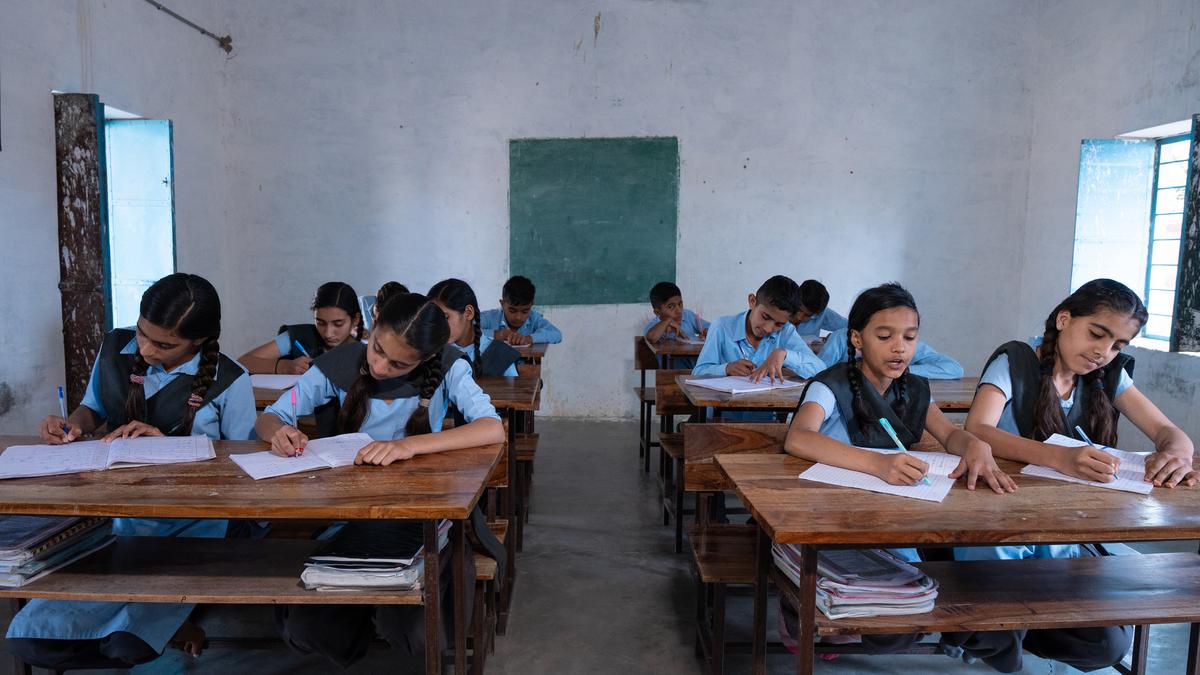
The Niti Aayog, India's premier policy think tank, has released a comprehensive decadal analysis of the country's school education system, highlighting significant challenges in student retention, learning outcomes, and infrastructure. The report, titled 'School Education System in India — Temporal Analysis and Policy Roadmap for Quality Enhancement', describes an education structure that resembles a "sharp pyramid," with a vast number of primary schools but a steep decline in schools at higher levels.
According to the report, India has achieved near-universal access to primary education, with 7.3 lakh primary schools serving a large student population. However, the number of schools drops sharply to just 1.64 lakh at the higher secondary level. This structural fragmentation means that only 5.4% of schools offer a continuous educational journey from Class 1 to 12. For the vast majority of students, progressing through grades requires switching institutions multiple times, which the report identifies as a significant barrier contributing to declining retention rates.
The report underscores that four out of every ten children entering the system drop out before completing higher secondary education. This "leaky pipeline" is exacerbated by the lack of established linkages between schools at different levels, forcing students to depend on local availability of institutions. The report also notes that close to 8,000 schools across the country reported zero student enrolment, with West Bengal (3,812) and Telangana (2,245) recording the highest numbers. These schools, despite having no students, continue to receive financial and human resources due to outdated administrative records, highlighting the disconnect between planning and ground reality.
Infrastructure deficiencies remain a major concern. Based on UDISE+ 2024-25 data, 1.19 lakh schools lack functional electricity. While access to drinking water has improved from 96.5% in 2014 to 99% in 2025, over 14,500 schools still lack functional water sources, and nearly 59,829 lack hand-washing facilities, compromising student health and hygiene. Internet connectivity has seen an eightfold increase to 63.5%, yet one-third of schools remain unconnected. Furthermore, 50% of government secondary schools operate without a science laboratory, limiting practical learning opportunities.
Learning outcomes present a persistent crisis. The report highlights that reading proficiency among Class 8 students has declined. In 2014, 74.7% of Class 8 students could read a Class 2 level text; by 2024, this figure fell to 71.1%. In mathematics, only 45.8% of Class 8 students can solve a basic division problem. Recent PARAKH 2024 findings indicate that while students perform well on rote memorisation, they struggle with real-world application. For instance, fewer than 30% of Class 6 students demonstrate competency in fractions.
To address these challenges, the report recommends a shift towards what it calls "cylindrical" schooling—creating composite schools that cover Classes 1-12 under one roof. This approach, it argues, could reduce the need for students to change schools at critical transitions and improve retention rates. The report also points out that the Right to Education Act ends at age 14, leaving families to bear the costs of tuition, books, and transport for older children, a factor that contributes to dropouts.
On technology integration, the report notes the Education Ministry's October 2025 announcement that Artificial Intelligence and Computational Thinking will be introduced from Class 3. While acknowledging the potential benefits, the report warns that without ethical frameworks and better teacher training, over-reliance on AI could "diminish independent thinking" in younger learners. It calls for a carefully designed approach to incorporating AI into the curriculum.
The Niti Aayog's findings serve as a critical reminder of the work needed to strengthen India's school education system. The report provides a policy roadmap aimed at enhancing quality, ensuring infrastructure, and improving student outcomes, with a focus on structural reforms and sustained investment.