Modi and Yunus Meet in Bangkok: Minorities, Border Tensions and Hasina in Focus
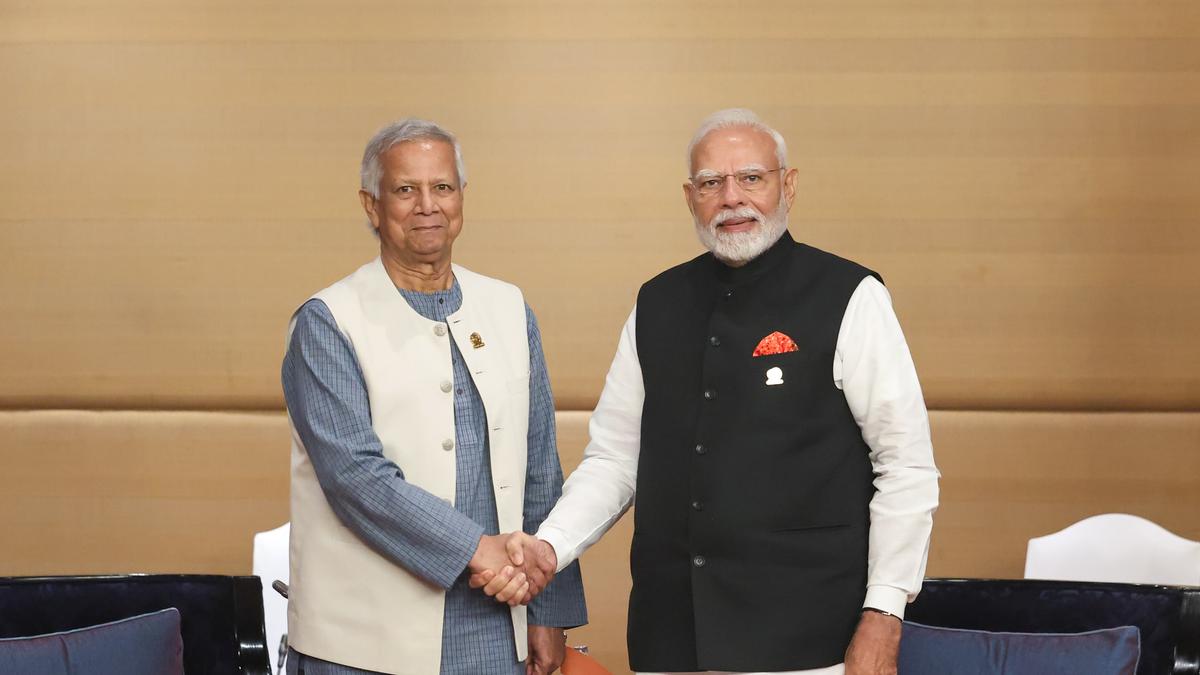
Prime Minister Narendra Modi and Bangladesh’s Chief Advisor Muhammad Yunus met on the sidelines of the BIMSTEC summit in Bangkok on Friday, their first meeting since the change of government in Dhaka eight months ago. The talks, lasting about 40 minutes, were held on cordial terms even as both sides raised contentious issues.
The meeting followed the sixth summit of the Bay of Bengal Initiative for Multi-Sectoral Technical and Economic Cooperation, a seven-nation grouping linking South Asia and South East Asia. Bangladesh will host the next BIMSTEC summit, and Mr Modi congratulated Mr Yunus on assuming the grouping’s chairmanship.
According to India’s Ministry of External Affairs, Mr Modi expressed India’s support for a “democratic, stable, peaceful, progressive and inclusive Bangladesh” and urged that “rhetoric that vitiates the environment is best avoided”. The MEA said both leaders discussed India’s call for the protection of minorities in Bangladesh, Dhaka’s demand for the extradition of former Prime Minister Sheikh Hasina, and border security issues.
Foreign Secretary Vikram Misri told the media after the meetings that the Prime Minister had expressed concern over the “safety and security of minorities, including Hindus”, who were targeted after Ms Hasina’s departure from Dhaka during protests in August 2024. Mr Modi hoped the Bangladesh government would fulfil its responsibilities seriously and ensure that these matters are properly investigated and addressed, Mr Misri said.
New Delhi and Dhaka did not indicate whether Mr Yunus, whose office had said it sought a visit to India, had received an invitation from Mr Modi. Sheikh Hasina, who resigned and left Bangladesh after the August 2024 protests, remains in India. Dhaka has demanded her extradition, a request that New Delhi has not accepted.
On the sidelines of the BIMSTEC summit, Mr Modi also met Myanmar’s junta chief and Prime Minister, General Min Aung Hlaing, for the first time since the military seized power in Myanmar in 2021. The MEA said Mr Modi underlined the importance of early restoration of the democratic process in Myanmar, including through credible and inclusive elections. General Min thanked India for assistance with relief efforts after devastating earthquakes hit Mandalay and other parts of Myanmar last week.
General Min’s invitation to the BIMSTEC summit was protested by the National Unity Government, led by Aung San Suu Kyi’s National League for Democracy, which was deposed in the 2021 coup. The NUG, now in exile, said in a statement that continued engagement with the military junta would only embolden its violent oppression and worsen Myanmar’s humanitarian crisis.
Mr Modi also met Nepal’s Prime Minister K.P. Sharma Oli, who took office in July 2024. In a social media post, Mr Modi described the meeting as “productive” and said the two leaders discussed India-Nepal friendship, especially in sectors like energy, connectivity, culture and digital technology. Neither side confirmed discussions on a Delhi visit by Mr Oli, which has been pending despite several requests from Kathmandu. Nepal’s Foreign Minister, Arzu Rana, had confirmed the request in an interview to The Hindu.
The three leaders — Mr Yunus, General Min and Mr Oli — have all chosen to visit China, while New Delhi has not issued invitations to them, amid tensions over a number of issues and concerns over the legitimacy of the governments in Dhaka and Naypyitaw. The Modi-Yunus meeting, however, was seen as a step toward keeping channels of communication open between India and its neighbours.







