Met Office warns developing El Niño could be strongest in living memory
The Met Office has warned that the El Niño event currently developing over the Pacific Ocean is likely to be the strongest in living memory. The natural climate phenomenon, which warms sea surface temperatures in the central and eastern Pacific, has far-reaching effects on weather patterns across the globe.
El Niño is one half of the larger El Niño-Southern Oscillation (ENSO) cycle. During an El Niño phase, the trade winds weaken, allowing warm water to spread eastward across the Pacific. This shift in ocean heat alters atmospheric circulation, leading to changes in rainfall, temperature, and storm activity in many regions. The phenomenon typically lasts for nine to twelve months, but its impacts can be felt long after it has subsided.
According to the Met Office, the current event is showing unprecedented intensity in its forecasts. Professor Adam Scaife, head of long-range forecasting at the Met Office, said, "We should be clear that this is an unprecedented event. I have never seen an El Niño signal this intense in our forecasts."
The warning comes with a dual concern: the natural variability of El Niño is now superimposed on the background trend of human-induced climate change. As a result, the Met Office says it is "very likely" that 2027 will be the hottest year on record globally. This combination can amplify extreme weather events, from heatwaves and droughts to floods and storms.
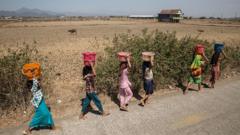
There is already growing evidence that weather patterns are being affected. India has seen below-average monsoon rainfall this year, which could have serious implications for agriculture and water resources. In the Atlantic Ocean, hurricane activity has been suppressed, a typical response to El Niño's influence on wind shear in the region. For the United Kingdom, long-range forecasts suggest an increased risk of a wet and stormy autumn, with signs of a very unsettled spell in the coming months.
While there is no clear evidence that climate change is making El Niño events themselves more frequent or intense, warmer global temperatures do intensify the impacts of such events. A warmer atmosphere holds more moisture, leading to heavier rainfall when conditions are favourable. Similarly, heatwaves during an El Niño year can be more severe in a warming world.
The Met Office's warning is part of a wider effort to improve early-warning systems for extreme climate events. Better forecasting allows governments and communities to prepare for potential disruptions in agriculture, water supply, and public health. Scientists around the world are closely monitoring the development of this El Niño and its potential effects in the coming months.
Historically, the El Niño events of 1997-98 and 2015-16 were among the strongest recorded, causing widespread droughts, floods, and disruption to fisheries in different parts of the world. The Met Office's current projections suggest that the upcoming event could rival or exceed those episodes, which is why it is being described as "strongest in living memory."
The term 'living memory' implies a comparison with events that people alive today can recall, typically meaning the last seven decades. If the forecast holds, this El Niño could be more powerful than any since at least the early 1950s.
However, scientists caution that forecasts carry uncertainty. The strength of an El Niño is measured by sea surface temperature anomalies, and these can evolve significantly over several months. The Met Office will continue to update its predictions as more data becomes available.
For now, the message to the world is one of preparedness. Whether it is farmers in India awaiting the next monsoon, residents of coastal areas bracing for storms, or policymakers planning for food security, the anticipated El Niño is a reminder of how deeply interconnected the Earth's climate system is.
In the coming weeks, the world will be watching the Pacific Ocean for further signs of the event's development. The Met Office's warning serves as a scientific assessment, not a certainty, but the stakes are high for a planet already grappling with the effects of climate change.