MEA: Removal of structures outside Pak High Commission was 'proportionate response'
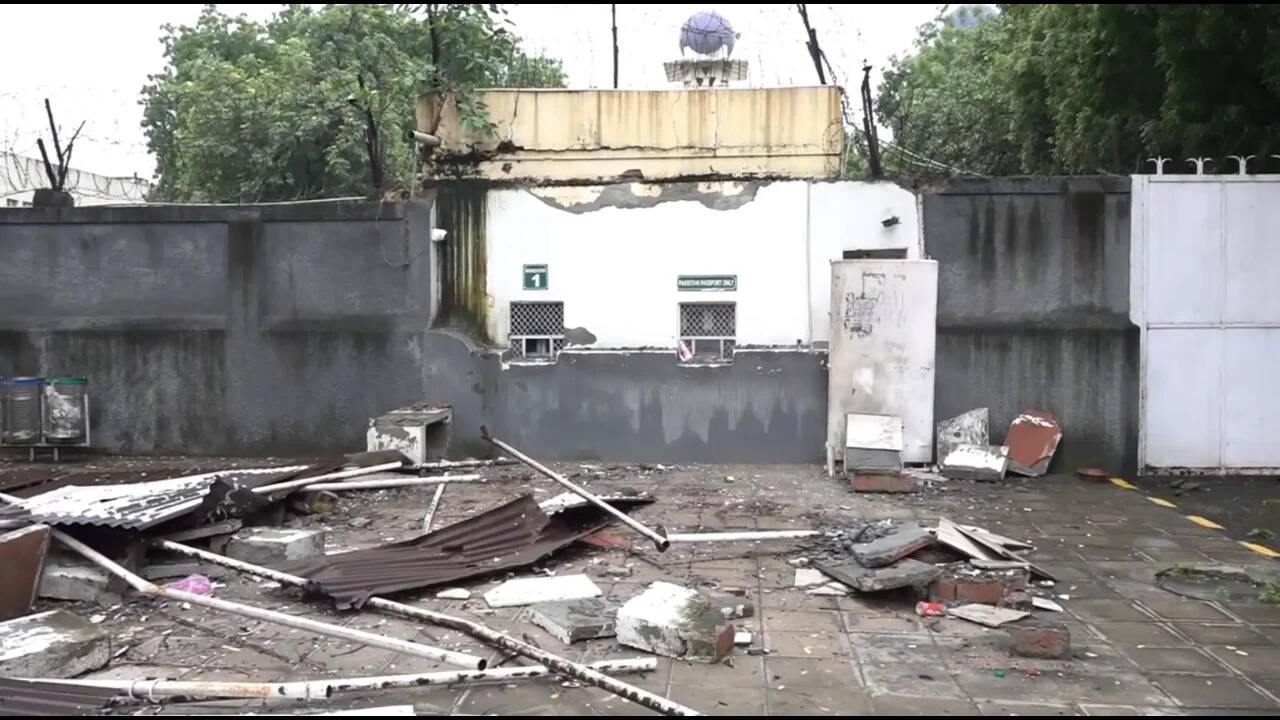
The Ministry of External Affairs (MEA) on Friday said the removal of unauthorised structures outside the Pakistan High Commission in New Delhi was a "proportionate action" taken in response to Pakistan's removal of structures near the Indian High Commission, despite India's request not to do so.
At the bi-weekly press briefing, MEA spokesperson Randhir Jaiswal said authorities in Islamabad had removed some structures in front of the Indian High Commission to facilitate parking. "Despite our request not to do so, they went ahead with the removal," he said. "We then took proportionate action in response. There were some temporary structures in the lane of the Pakistani High Commission, which we removed."
The action carried out on Thursday involved the dismantling of temporary structures and queue-management barriers that had been erected outside the Pakistan High Commission. Visuals from the site showed debris scattered over the paved area, including broken metal railings, twisted frames, roofing sheets, bricks, and chunks of concrete and plaster. Parts of the outer structures, including corrugated roofing and white metal fencing, were completely demolished.
The visa section of the high commission remained visible amid the debris. Service windows marked "Window 1", "Pakistani Passport Only", and "Window-5 / Collection of Visa Applications" could be seen, though the surrounding area appeared damaged, with portions of plaster and masonry broken away. Broken fencing and construction material were also present near the counters.
The MEA did not provide further details about the operation or mention any additional steps. Pakistan's mission in New Delhi had not issued a public response at the time of writing.
Diplomatic premises are protected under the Vienna Convention on Diplomatic Relations, which obligates host countries to safeguard foreign missions. However, the exact boundaries of such premises and the permissible use of adjacent lanes can sometimes become points of contention. In this case, the structures removed were located in the lane outside the high commission, not within the main building. The queue-management barriers had been placed in the area around the visa section, which remains a busy part of the compound.
The MEA's framing of the action as "proportionate" indicates that New Delhi viewed Pakistan's earlier removal of structures as a departure from the understanding between the two countries. Both India and Pakistan have historically maintained reciprocal arrangements regarding their high commissions, and any unilateral change has often drawn a calibrated response.
India and Pakistan have had a fraught relationship since their independence, with periodic attempts at dialogue interspersed with crises. The functioning of their diplomatic missions has occasionally been affected by these tensions, though both sides have generally taken care to avoid direct harm to diplomatic personnel. The current incident adds to the existing strain in bilateral relations, which have seen limited diplomatic engagement on multiple fronts.
The removal of temporary structures may seem like a minor procedural matter, but the public manner in which it was carried out and the MEA's explicit linkage to Pakistan's actions suggest that it was intended as a signal. Observers note that reciprocal measures of this kind are not unprecedented in diplomatic practice.
The immediate question is whether the issue will be resolved quietly through diplomatic channels or whether it will lead to further actions. As of now, official statements from both sides have been measured, and there is no indication of any immediate escalation. The situation is being closely watched, as even small disputes over diplomatic premises can have broader implications for bilateral ties.







