Mamata Banerjee leads protest march in Kolkata demanding rehabilitation before hawker eviction
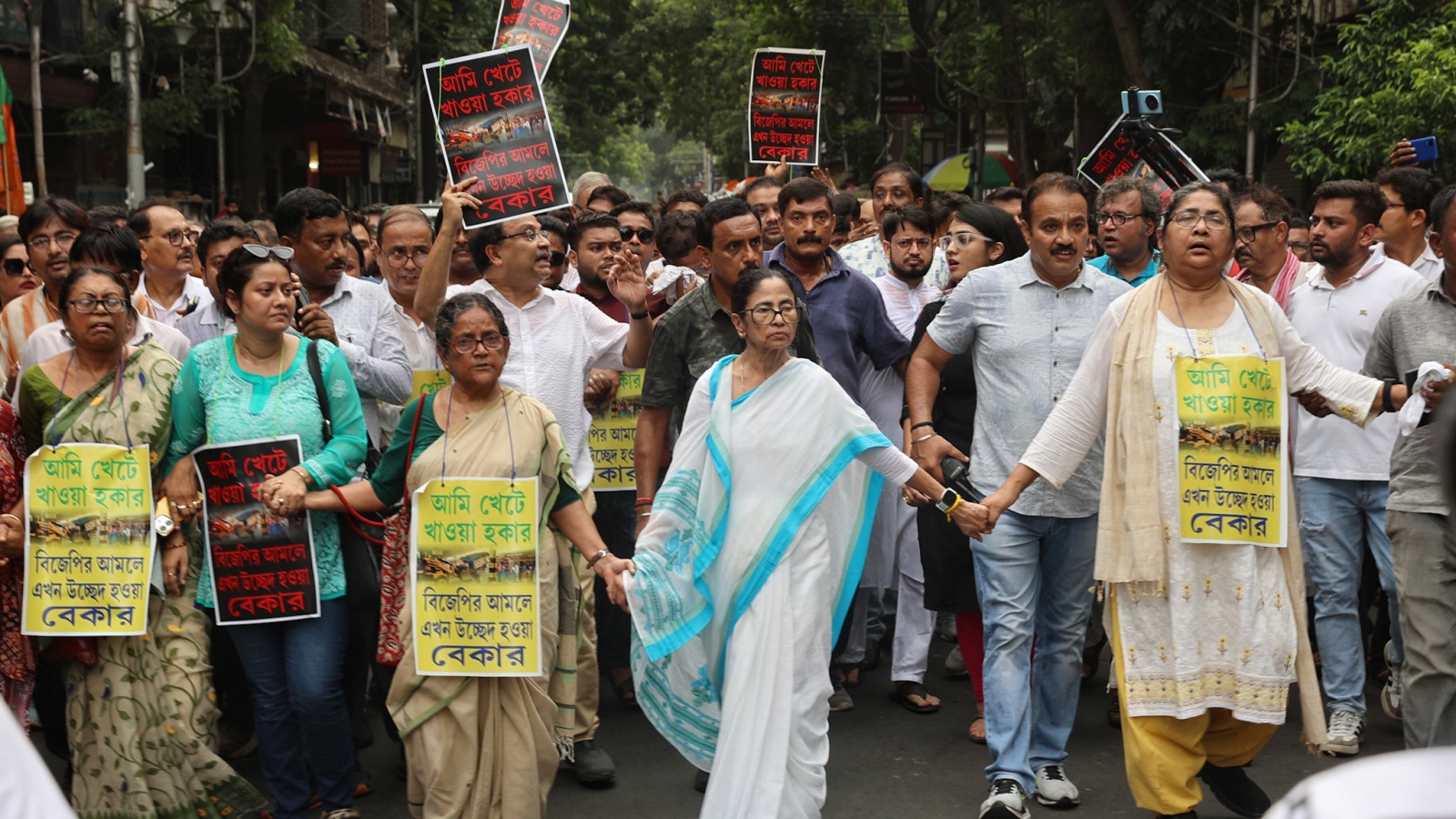
Trinamool Congress (TMC) chief Mamata Banerjee on Wednesday led a protest march through central Kolkata against the eviction of hawkers, asserting that rehabilitation must precede any drive to remove roadside vendors. The march, covering nearly 1.2 kilometres from Dharmatala to Subodh Mullick Square, saw participation from party leaders, workers, and supporters, who described the eviction drives as “illegal, unjust and deeply inhuman.”
Accompanied by Beleghata MLA Kunal Ghosh, former MP Dola Sen, and other senior functionaries, Banerjee reached the Esplanade area before heading the procession. The TMC later issued a statement on social media, accusing the opposition of pursuing anti-people policies and vowing to safeguard the dignity and livelihoods of hawkers.
The issue of street vending in Kolkata is both politically sensitive and legally complex. The informal sector employs a significant portion of the city’s population, with an estimated two lakh hawkers operating across various markets. Successive governments have grappled with balancing the right to livelihood against the need for orderly pavements and pedestrian safety. The West Bengal government, under Banerjee’s leadership, framed a policy in 2020 that sought to address these concerns by designating vending zones and forming town vending committees, as mandated by a central law of 2014.
However, implementation has been uneven, and periodic eviction drives—often triggered by court orders, fire incidents, or infrastructure development—have sparked protests. In many instances, vendors claim they have been displaced without adequate notice or alternative arrangements, a grievance echoed by the TMC in its current campaign. The party’s demand for a “rehabilitation first” approach draws on a model previously attempted in some parts of Kolkata, such as the Gariahat market, where a limited number of hawkers were relocated to designated vending hubs.
During the march, Banerjee emphasised that her government stood with the people and would not allow any “ruthless eviction” to proceed without addressing the livelihood concerns of those affected. She described hawkers as integral to the city’s character and economy, and reiterated that her administration would explore all legal and administrative avenues to protect them. The protest was largely peaceful, with participants holding placards and raising slogans in support of hawkers’ rights.
Reactions from the political opposition have been varied. While some have accused the TMC of encouraging illegal encroachments for political gains, others have pointed to the state government’s own record of conducting evictions in the past. The BJP, the principal opposition party in West Bengal, has often criticised the TMC’s handling of the hawker issue, alleging a nexus between the ruling party and hawkers’ unions. The TMC, however, maintains that its protests are directed against what it calls the “anti-people” agenda of the opposition, which it claims is influencing civic authorities.
Legal battles over hawking rights continue to play out in the Calcutta High Court, where multiple petitions have sought stricter enforcement of pavement clearance. The tussle reflects a broader national challenge, as India’s Street Vendors Act mandates that states protect vendors’ livelihoods while ensuring unencumbered use of pavements. In West Bengal, the formation of vending committees has been sluggish, leading to ad-hoc arrangements and periodic conflicts.
Banerjee’s protest comes at a time when the TMC is gearing up for a series of electoral contests, and the hawker community remains an important support base for the party. Observers note that the demonstration served both as a show of solidarity with the urban poor and as a political message to challengers. The TMC chief promised that her party would “leave no stone unturned” in the fight for hawkers, reaffirming its commitment to the theme of people’s welfare that has been central to its governance narrative.
As the march dispersed, Banerjee reiterated that any eviction must be preceded by transparent rehabilitation schemes, and called upon civic bodies to halt the ongoing drives until a comprehensive plan is in place. The TMC’s stance underscores the enduring tension between urban development and informal livelihoods in India, a dilemma that continues to shape political discourse in Kolkata.


