Journalists' bodies condemn detention of reporters at Delhi protest, demand release
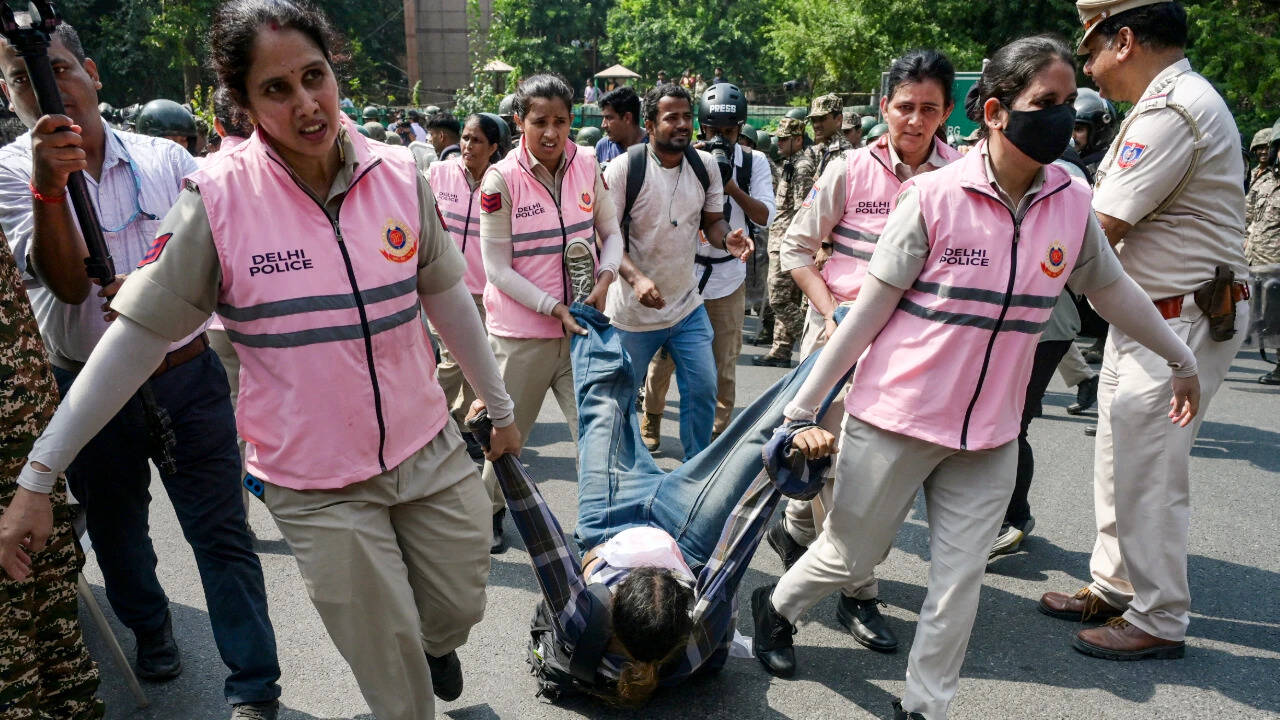
Four journalists' organisations have condemned the detention of reporters who were covering protests in Delhi, describing the action as an attack on press freedom and demanding the immediate release of all those held.
The Press Club of India (PCI), the Indian Women's Press Corps (IWPC), the Delhi Union of Journalists (DUJ) and the Delhi unit of the Kerala Union of Working Journalists (KUWJ) issued a joint statement on Saturday, news agency PTI reported. The protests were held to press for the resignation of Chief Election Commissioner Gyanesh Kumar.
According to the statement, journalists covering the demonstrations were put on buses and taken to locations including Chhatrasal Stadium and Chanakyapuri police station, along with hundreds of protesters detained by the police. The organisations said the reporters were filming the detentions when they were taken into custody, even though they were carrying valid press identity cards.
Some journalists, the statement said, had their mobile phones and reporting equipment seized. It also cited complaints that police officers refused to recognise their press credentials, with some allegedly saying, "Everybody claims to be a journalist these days."
The four bodies objected in particular to the Delhi Police's reported position that only journalists accredited by the Press Information Bureau (PIB) would be allowed to cover the protests. "Press freedom in India cannot be conditional on PIB accreditation. A large section of digital and independent media does not have PIB cards, yet they are recognised press under the law," they said.
The organisations said they had raised these concerns in a memorandum to the Delhi Police Commissioner earlier in the week, but that their recommendations had not been addressed. They demanded an inquiry into the role of senior officers who, they allege, ordered the detentions even after being shown press cards; the return of seized equipment; a public apology from the Delhi Police; and an assurance that reporters would be able to cover demonstrations without interference.
In their statement, they also linked the detentions to broader restrictions in the capital, referring to the deployment of about 22,000 police and paramilitary personnel, the closure of metro stations and internet shutdowns. Such measures, they said, undermined the ability of the media to report on public protests and to question institutions. In strong language, the organisations said the situation was "reminiscent of a fascist state".
The dispute touches on a long-established constitutional principle. In India, press freedom flows from the right to freedom of speech and expression guaranteed by Article 19(1)(a) of the Constitution, subject to the reasonable restrictions permitted under Article 19(2). Courts have repeatedly held that this right extends to all persons engaged in gathering and disseminating information, and does not depend on holding any particular accreditation.
The allegations in the joint statement have not been independently verified, and no response from the Delhi Police or the Election Commission was included in the accounts available at the time of writing. Detentions at large public gatherings in Indian cities are generally justified by the police as necessary to maintain public order and to enforce prohibitory orders, and action is usually said to be taken against those held to be violating such orders.
The organisations said the detentions went ahead despite their earlier representation to the police leadership, a development they said showed the need for clearer protocols on how working journalists are to be treated during protests and public order operations.







