Jaishankar: Deal with China confidently; outlines 3Cs and 4Ds for a changing world
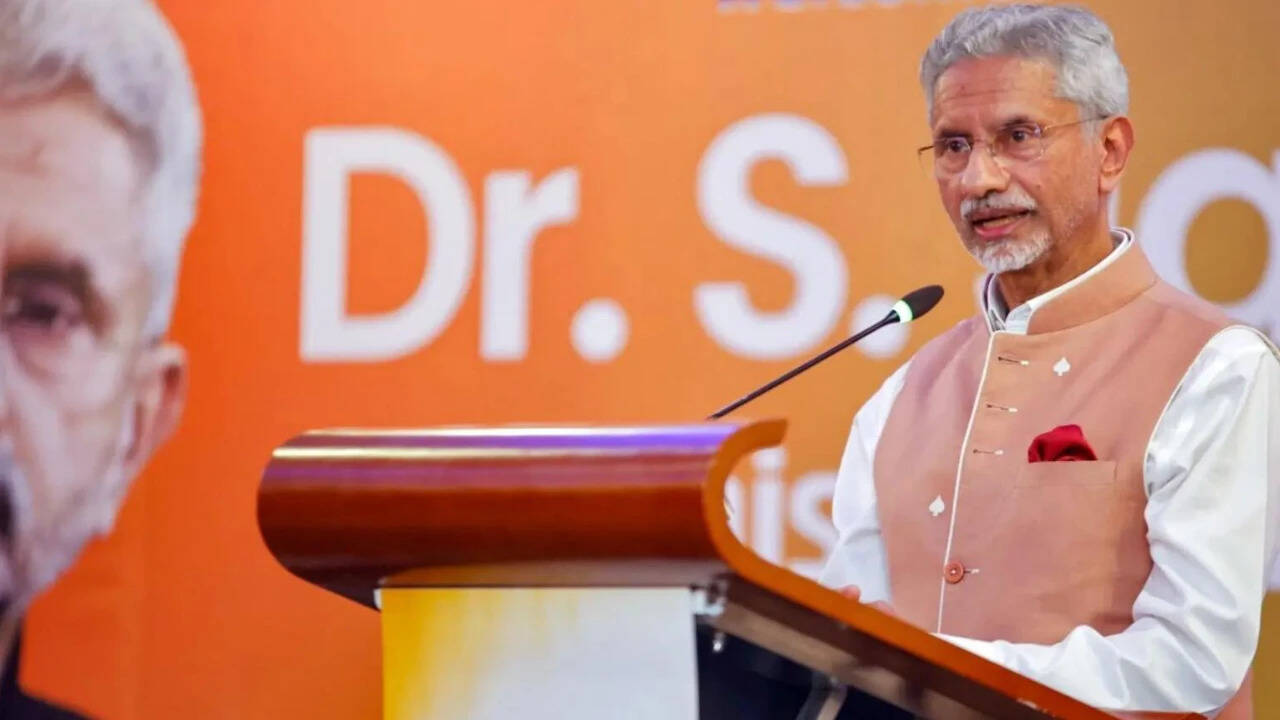
NEW DELHI: External affairs minister S Jaishankar on Saturday offered a candid assessment of a rapidly changing global landscape, warning that growing geopolitical and economic tensions are creating new challenges for countries and businesses. He stressed that India must remain engaged with the world's major economies while strengthening its own industrial and economic capabilities.
Speaking at the Economic Times World Leaders Forum 2026, Jaishankar said the emerging global environment required countries to reduce vulnerabilities, broaden economic options and prepare for disruptions rather than rely on assumptions of stability.
He framed his assessment around three defining features of the present world order: competition, conflict, and the growing use of economic and strategic leverage. To navigate these pressures, he proposed a four-part approach focused on reducing risks, diversifying partnerships and sources, addressing market distortions, and maintaining a margin of safety.
On China, Jaishankar said India should continue doing business with Beijing while developing the domestic strength needed to compete with it. Greater self-reliance, industrialisation and manufacturing capacity would allow India to engage China more confidently rather than disengage from it. "We have to do business with the entire world. That includes China too. But it is important we deal with them confidently," he said.
Jaishankar noted that India-China relations had gone through a difficult period between 2020 and 2024 because of the border situation, but both countries had an interest in maintaining stable ties. He also said India needed to make up for decades of shortcomings in building its manufacturing and industrial base. "So I think a stronger, more self-reliant India, a more industrialised India, a more manufacturing India will be able to actually compete with China as it will with other major countries of the world."
Describing his view of the world as "not a very comforting answer," Jaishankar said countries were pushing their interests to a point where competition could turn into conflict. He pointed to the Russia-Ukraine conflict and the West Asia conflict as examples, noting that one had entered its fifth year while there was still no clear "light at the end of the tunnel" for the other.
He said competition was no longer confined to traditional geopolitical rivalry, with economic and strategic tools increasingly being "weaponised." "This is a world increasingly characterised by choke points," he said, explaining that a choke point emerges when "a country or a set of countries have established dominance" in a particular field and are prepared to use that dominance to exert pressure. Such leverage can "inflict pain" on others, while countries exercising it may believe they are sufficiently insulated from the consequences.
Outlining the response, Jaishankar said, "If I declare the problems in terms of Cs, maybe I move an alphabet beyond," presenting derisking as his first and "biggest mantra." The response includes diversifying partnerships and sources, addressing market distortions, and maintaining a margin of safety.
The minister's remarks come at a time when India is navigating complex global relationships and seeking to balance economic engagement with strategic autonomy.







