ISRO Chief Calls for Greater Focus on Science Missions, Increased Funding
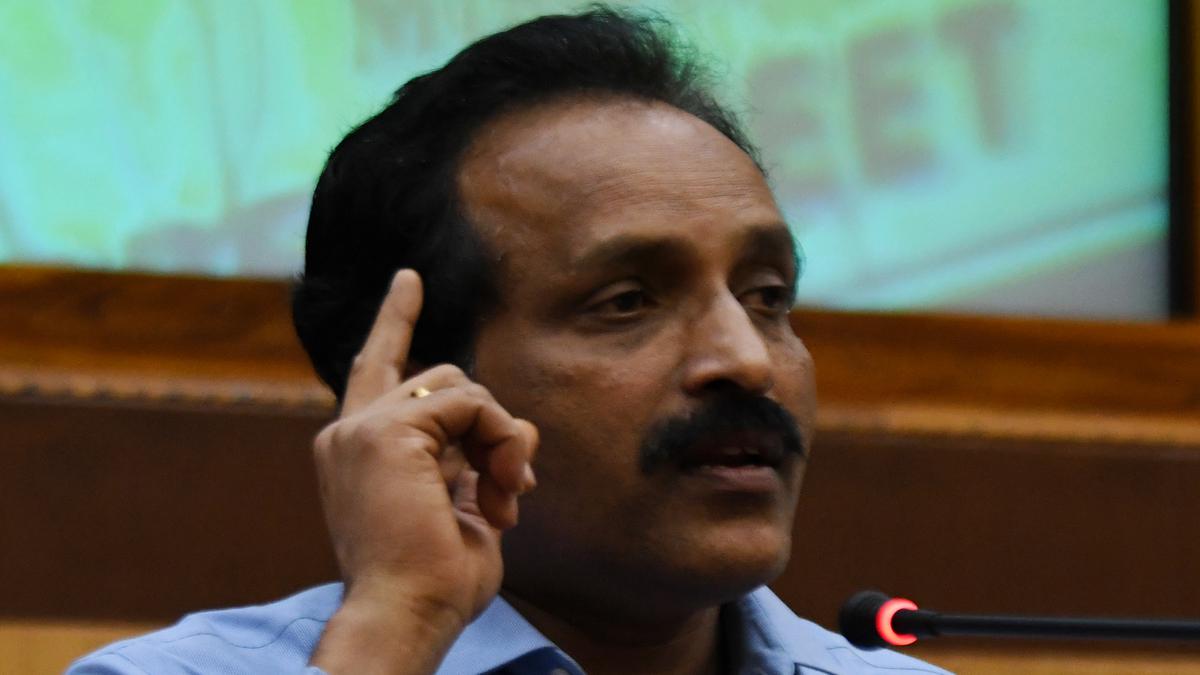
In a recent interaction with The Hindu, Indian Space Research Organisation (ISRO) Chairman S. Somanath emphasised the need to prioritise scientific missions in India's space programme, while acknowledging the current limitations imposed by budget constraints.
His remarks come shortly after the successful launch of 36 OneWeb satellites aboard the LVM3 launch vehicle, a commercial mission. When asked whether commercial launches are overshadowing scientific objectives, Mr. Somanath clarified that the space sector operates on demand. He noted that ISRO has launched 53 satellites for various purposes but only four dedicated science missions, highlighting the historical underemphasis on scientific exploration.
"Science was never a priority but it must become the priority in the future," he said. "We've always had a very limited budget for science but we need more money so that we can do science missions. We are not doing enough in science but if we prioritise science, we will not get money."
The ISRO chief also addressed the forthcoming space policy, which is expected to define the role of non-governmental entities in India's space sector. He clarified that the policy would not prescribe organisational structures but would articulate the intent to expand private participation. "Policy only spells out the intent and that is to have more non-governmental entities enter the space sector," he explained.
Responding to a question about whether ISRO aspires to become like NASA, Mr. Somanath stressed that the Indian space agency operates under a different ecosystem. "In India, there is no industry capable of doing anything independently. Thus, ISRO's role is to mentor and develop the industry ecosystem here," he said. He added that comparisons with other countries are not useful at this stage, as India is charting its own model.
The Chandrayaan-3 mission, which aims to place a rover on the Moon, is now expected to launch in June 2023, a delay attributed to technical preparations. The mission is seen as a critical step in India's lunar exploration efforts after the partial failure of Chandrayaan-2 in 2019.
Mr. Somanath's comments underline a growing debate within India's space community about balancing commercial viability with scientific ambition. While ISRO has achieved global recognition for cost-effective satellite launches, its scientific payloads have remained modest in scale. Experts argue that sustained investment in science missions is essential for long-term technological advancement and global standing.
India's space budget remains a fraction of NASA's, and the demand for commercial launches has grown steadily, particularly with the rise of private players like OneWeb. The new space policy is expected to provide a clearer framework for private participation, potentially freeing ISRO to focus more on research and exploration.
The upcoming policy and the launch of Chandrayaan-3 will be watched closely as indicators of India's future direction in space. For now, Mr. Somanath's call for greater scientific focus and funding sets the tone for what may be a pivotal year for ISRO.