India's Robot Density Remains Dismally Low Despite Manufacturing Push
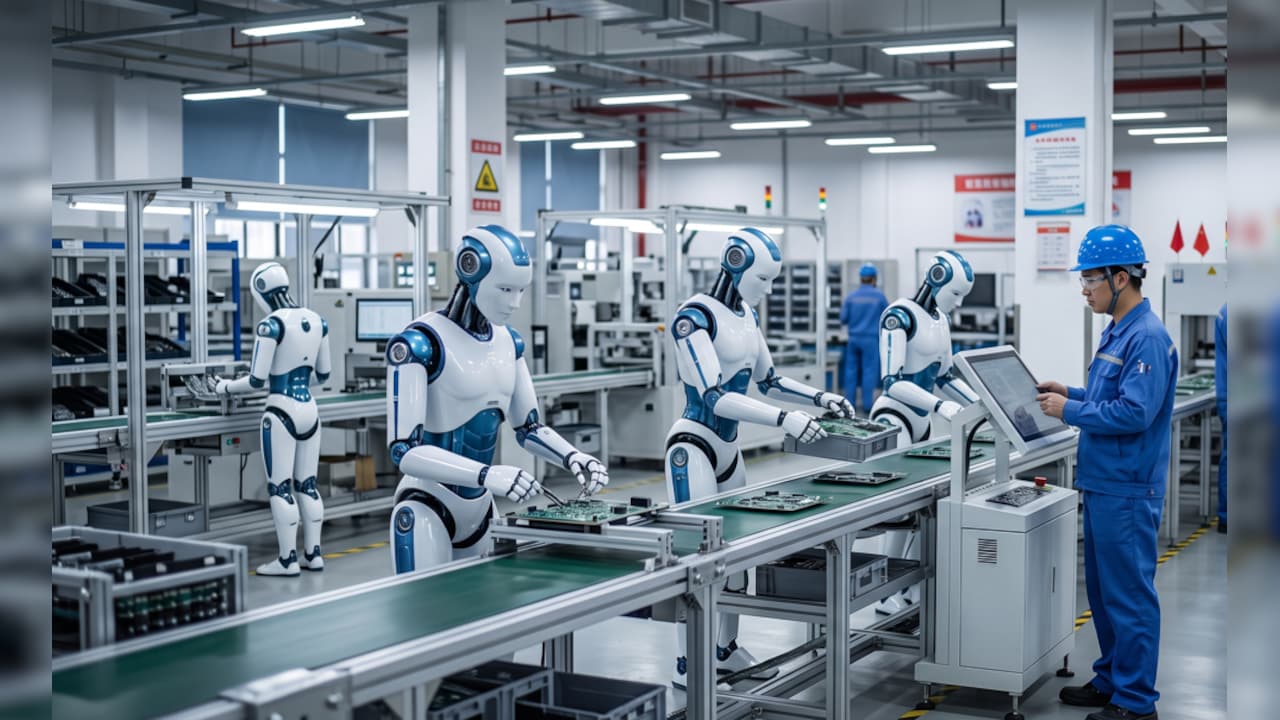
India's factories are expanding, but the machines that could make them globally competitive are conspicuously absent. While Production Linked Incentive (PLI) schemes have attracted over Rs 2.16 lakh crore in investment and boosted electronics manufacturing from $37 billion to more than $115 billion in under a decade, the country's factory floors remain among the least automated in the world.
According to the International Federation of Robotics (IFR), India has just six industrial robots per 10,000 manufacturing workers. This places it far behind the global average of 131, and even further behind leaders like South Korea (1,220), Singapore (818), Germany (449), and Japan (446). Even China, often dismissed as a low-cost assembly line, has quadrupled its robot density since 2017 and now operates more than half of all robots installed globally in 2024 alone.
Industry experts argue that this automation gap, not the number of factories, is the real challenge for India's goal of becoming a $5 trillion economy. "The future of industrial development will be shaped by productivity, precision and the ability to manufacture at globally competitive levels," says Prateek Jain, COO and Co-founder of Addverb, a robotics firm. "Robotics is no longer a factory upgrade. It has become a national competitiveness imperative."
There is, however, a notable bright spot. On annual robot installations, India now ranks sixth in the world, ahead of countries like the UK and Italy, having climbed from tenth place just three years ago. In 2024, India installed a record 9,100 robots, a 7 per cent increase from the previous year.
Yet the distribution of these installations reveals a structural imbalance. The automotive industry accounts for 45 per cent of all robot deployments in India. Sectors such as textiles, pharmaceutical packaging, and electronics assembly—precisely the industries that PLI incentives aim to strengthen—remain largely untouched by automation.
Looking ahead, experts suggest that India should study China's approach rather than that of South Korea or Singapore. Both are small, wealthy, export-driven economies with relatively tiny workforces, making them unrealistic benchmarks for a country of India's scale. China, by contrast, faced a similar challenge a decade ago: a massive, low-automation manufacturing base attempting to move up the value chain.
China's solution was not simply to import robots, but to build an entire ecosystem around them—domestic robot manufacturers, component supply chains, testing infrastructure, and enough scale to bring down costs for everyone, including small enterprises. Jain points to this model as a blueprint for India. "Robotics clusters, indigenous component manufacturing, AI-powered industrial software, testing facilities and stronger industry-academia collaboration can significantly reduce automation costs, especially for MSMEs," he says.
Another emerging factor is the Gulf region, with Saudi Arabia projecting that its robotics and automation push could add over $135 billion to its economy. This adds a new dimension to the global race for automation leadership.
For India, the path to Viksit Bharat 2047 will depend not just on building more factories, but on making those factories productive enough to compete on the world stage. The data suggests that bridging the automation gap is not merely a technological challenge, but a strategic economic one.