India's GOBARdhan scheme: Rs 23,731-crore plan to turn farm waste into fuel
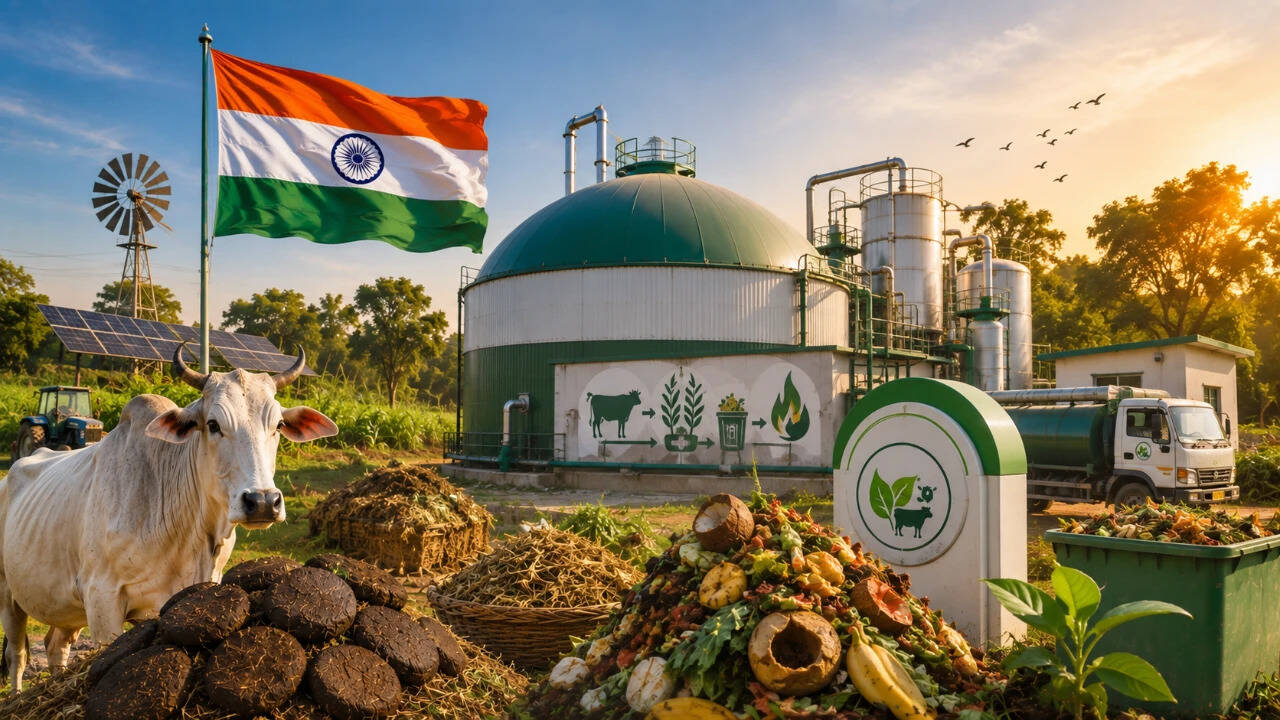
The Union Cabinet has approved GOBARdhan, the National Circular Bioenergy Scheme, with a total outlay of Rs 23,731 crore for the period from FY 2026-27 to FY 2035-36. The scheme aims to increase India's Compressed Biogas (CBG) production ten-fold, bringing together assured demand, stable pricing, capital assistance, pipeline infrastructure and credit under a single national framework.
GOBARdhan was originally launched in 2018 under the Swachh Bharat Mission-Grameen as a waste-management programme. Its initial focus was on converting cattle dung, kitchen waste, crop residue and other organic material into biogas and bio-slurry. The updated version, however, is far broader. It is now positioned as a national framework for the CBG industry and placed under the Ministry of Petroleum and Natural Gas.
The scheme merges several existing initiatives, including the Sustainable Alternative Towards Affordable Transportation (SATAT) initiative, the Market Development Assistance scheme for organic manure, the Biomass Aggregation Machinery scheme, pipeline infrastructure support and central financial assistance for CBG plants. In effect, the government is moving from a waste-disposal approach to an industry-building approach.
The process itself is straightforward. Organic material such as cattle dung, agricultural residue, press mud from sugar mills and municipal organic waste is fed into an anaerobic digester. Microorganisms break down the material in the absence of oxygen, producing biogas. This raw biogas is then purified to remove carbon dioxide and impurities, and compressed. The resulting CBG has properties comparable to natural gas and can be used in the existing gas ecosystem, which means India does not need to build a separate fuel infrastructure for it. The process also produces bio-slurry, which can be used as organic manure.
India has a strong reason to pursue this fuel. The country imports a large share of its natural gas requirements, and CBG offers a domestic, renewable alternative. It also helps address the chronic problem of crop residue burning, which contributes to severe air pollution in northern India, and provides a way to manage organic waste in cities and villages.
Yet earlier attempts at building a CBG industry have struggled. Several plants commissioned under the SATAT initiative faced difficulties in securing reliable feedstock, obtaining bank loans, and finding buyers at viable prices. The lack of pipelines to transport the gas to consumers was a major obstacle, as was the absence of an assured market.
The new scheme attempts to address these issues through a set of structured interventions. It provides capital assistance to reduce the upfront cost of setting up plants. It introduces a stable pricing mechanism so that producers have a predictable revenue stream. It supports pipeline connectivity between plants and buyers, and offers credit guarantees to make it easier for entrepreneurs to borrow. A district-level ecosystem fund has also been created to support the collection and aggregation of biomass at the local level.
For farmers, this could open up a new source of income. They can sell agricultural residue and cattle dung, and also benefit from the organic manure produced by biogas plants. The scheme envisages villages becoming centres of energy production, with farmers acting as suppliers to the energy industry.
Currently, India's CBG industry is small. According to official figures, the country has a limited number of operational plants, and production is far below its potential. The government aims to change this significantly over the next decade, with a target of increasing domestic CBG production ten-fold by 2035-36.
The success of GOBARdhan will depend on execution. The scheme's integrated approach addresses many of the past shortcomings, but the real test lies in how quickly and efficiently it is implemented on the ground. If it works, India could gain a cleaner fuel, a new income stream for farmers, and a way to tackle waste and pollution simultaneously.







