India secure landmark women's Test victory at Lord's, defeating England by 270 runs
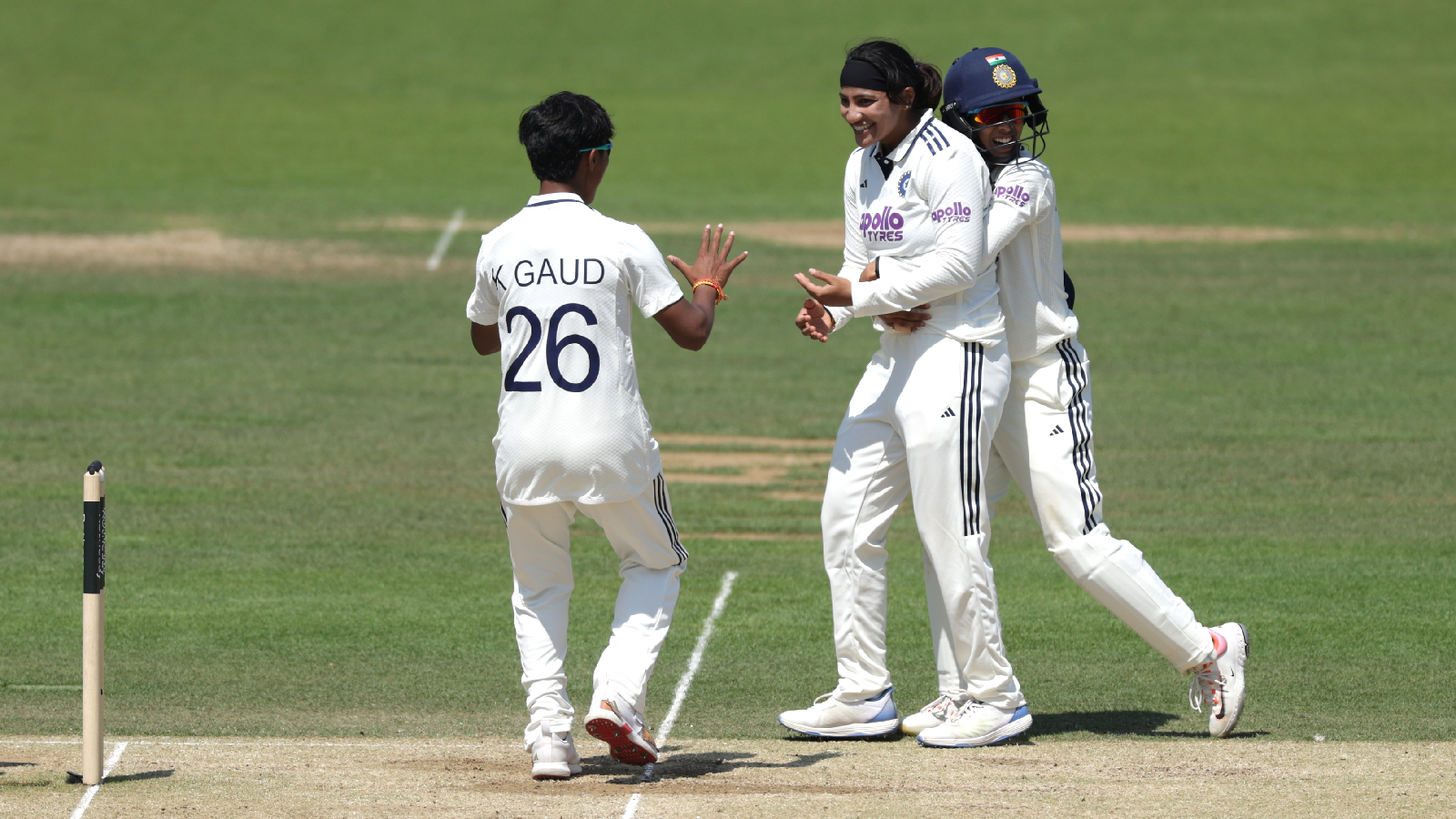
Sneh Rana was not part of India’s Women’s T20 World Cup squad. Even when Shreyanka Patil was ruled out through injury, the selectors looked elsewhere for a replacement. On Monday morning at Lord’s, Rana had the final word.
With Sophie Ecclestone mounting a stubborn resistance that threatened to prolong India’s wait, Rana floated one up outside off with plenty of revolutions in the fifth ball of the 63rd over. Ecclestone lunged forward to smother the spin, but the ball dipped late, gripped and burst through the gap between bat and pad before crashing into the stumps.
If cricket grounds are made of memories, Lord’s is haunted by legends – mostly men, all in white. Forty years after their first Test tour of England, Indian women tore up the script.
Just two weeks after heartbreak against Australia on this same ground, India stormed back to St John’s Wood and found redemption. Beating England by 270 runs, Harmanpreet Kaur’s team didn’t just win their first Test at Lord’s – they rewrote the history books.
This was India’s third Test victory on English soil, but it was easily their most iconic. Their first came at Taunton in 2006, their second at Wormsley in 2014. Lord’s, the most famous address in cricket, became the stage where India completed a journey that had begun nearly four decades earlier.
Before this Test, India’s women had played nine matches in England since that first tour in 1986, winning two and drawing seven. They had competed against some of the strongest sides in the world, produced memorable performances and come close on several occasions. But Lord’s remained unexplored territory.
The victory was not built around one individual. It was a reflection of a team that found a different hero whenever the match demanded one.
Kranti Gaud announced herself on one of cricket’s grandest stages. The young pacer showed remarkable composure, repeatedly challenging England’s batters with movement, accuracy and discipline, finishing with seven wickets in the match and also winning the Player of the Match award for her exploits.
Yastika Bhatia produced the knock that changed the direction of the match. She combined patience with aggression to score a magnificent 113, and her century was pivotal to India posting a daunting score for England to chase in the second innings.
Smriti Mandhana once again underlined her importance with twin half-centuries, while Deepti Sharma’s first-innings fifty steadied India after a wobble to ensure they reached a score they could compete with in the first innings.
The contributions around them were just as important. Rana contributed with bat and ball, while Sayali Satghare backed up her impressive Perth performance against Australia earlier in the year with another assured bowling display at Lord’s.
Harmanpreet Kaur’s fifty in the first innings and her bowling changes in both innings, combined with her calm leadership on the field, held India together.
The significance of the victory also comes from its timing. Some members had been part of the team that suffered a painful exit from the Women’s T20 World Cup after losing to Australia at Lord’s just two weeks earlier. They returned to the same ground, this time in the longest format, and created a memory that would last far longer.
When Monday began, India needed four wickets to complete a historic victory. England, however, was not ready to surrender, and the lower-order made India work for every breakthrough.
Rana provided the first breakthrough. Amy Jones had fought hard and reached 54, but a pull shot that could have brought valuable runs instead found Shafali Verma at mid-wicket. The dismissal removed England’s last recognised batter and gave India renewed belief.
Harmanpreet continued to rotate her bowlers, trusting every option at her disposal. The decision soon paid off when Deepti produced a moment of magic against Issy Wong.







