India Rejects UN Rights Body's Concerns Over Delhi Protest Crackdown, Cites 'Double Standards'
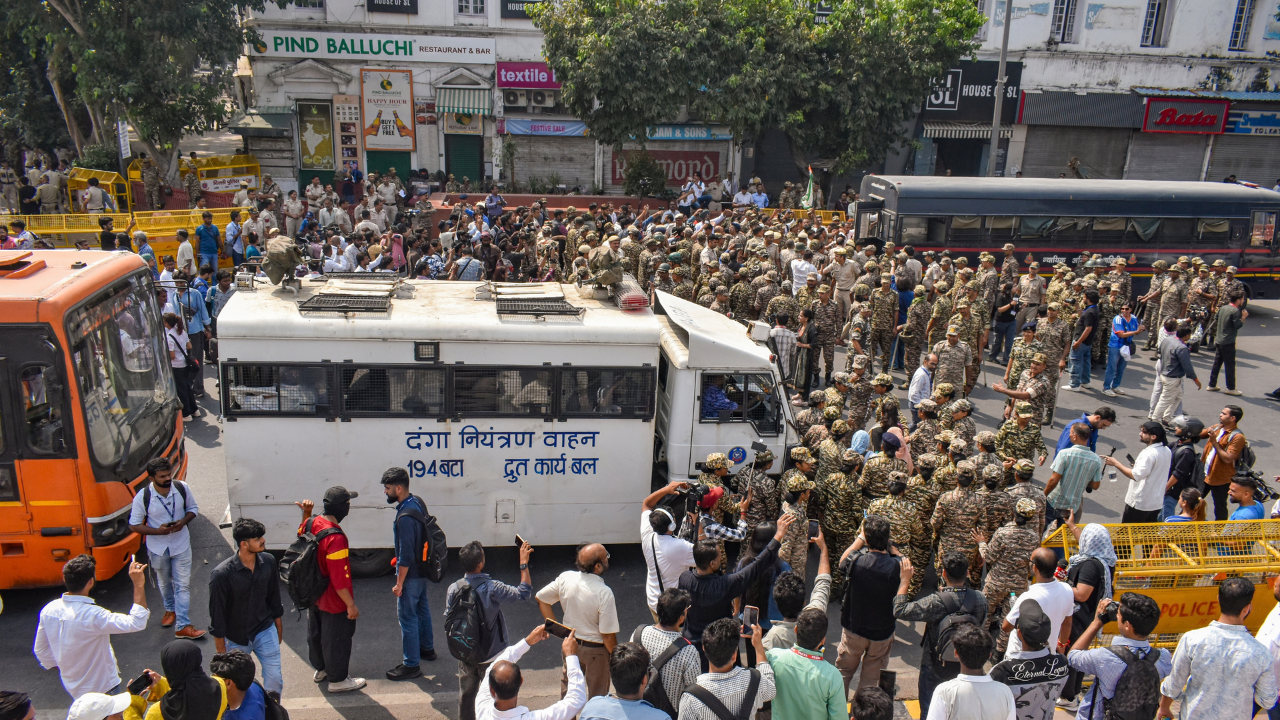
New Delhi: India on Sunday rejected the United Nations human rights office's concerns over a security crackdown in the capital ahead of a proposed protest, describing the remarks as "unwarranted" and an "unacceptable interference" in the country's internal affairs.
In a statement, the Ministry of External Affairs (MEA) said India is the world's largest democracy, where the right to peaceful assembly is guaranteed by the Constitution and safeguarded by robust institutions, an independent judiciary and a free media.
"As in every democracy, Indian citizens exercise this right subject to the maintenance of public order and safety. Our law enforcement authorities act strictly in accordance with the law, and our courts remain available to all for the redressal of any grievances," the ministry said.
The MEA also accused the Office of the UN High Commissioner for Human Rights (OHCHR) of being selective in its public statements, alleging that it had remained silent on violent responses to protests in neighbouring countries and on law enforcement actions closer to its own headquarters. "Such double standards only erode the credibility of its standing and contribute to the loss of faith in multilateralism," the statement said.
The response followed remarks by the UN High Commissioner for Human Rights a day earlier, expressing concern over reports of mass detentions of demonstrators, protest leaders, civil society members, lawyers and journalists before and during large-scale demonstrations in Delhi.
"We call on the authorities to ensure that the right to peaceful assembly is fully respected and fulfilled. Restrictions on peaceful protests must meet strict tests of necessity and proportionality," the high commissioner said.
What prompted the stand-off
The proposed demonstration was called by the Cockroach Janta Party (CJP) and sought the removal of Chief Election Commissioner Gyanesh Kumar over the Special Intensive Revision (SIR) of electoral rolls.
The SIR is an exercise in which electoral rolls are revised through house-to-house verification of electors' details. Several opposition parties and civil society groups have objected to the process, arguing that it risks leaving eligible voters off the rolls. Authorities have defended it as a routine clean-up of electoral records.
The proposed protest was met with a heavy security deployment, and several political leaders and demonstrators were detained, according to reports. This publication has not independently verified the number of people detained.
What the law says
Article 19(1)(b) of the Constitution guarantees citizens the right to assemble peaceably and without arms. Article 19(2) permits the State to impose reasonable restrictions in the interests of the sovereignty and integrity of India, public order and other specified grounds.
Courts have repeatedly held that curbs on peaceful assembly must satisfy tests of necessity and proportionality, and that prohibitory orders — such as those issued under Section 163 of the Bharatiya Nagarik Suraksha Sanhita, which replaced Section 144 of the Code of Criminal Procedure — cannot amount to a blanket ban. Detentions must follow due process, and those held retain the right to approach courts for redress.
The wider context
The exchange reflects a long-standing difference between India and UN human rights mechanisms. India has consistently held that human rights scrutiny should proceed through dialogue and cooperation, and has objected to what it sees as selective, country-specific attention. The OHCHR, for its part, says it raises concerns based on verified reports from its monitoring and from civil society.
India's reference to multilateralism also touches on a wider concern voiced by several countries about the credibility of international institutions at a time when multilateral bodies face pressure on multiple fronts.
The MEA statement was issued on Sunday, a day after the OHCHR's remarks. It was not immediately clear whether the two sides would continue the exchange through formal channels.







