India and New Zealand Elevate Ties to Strategic Partnership, Sign Defence and Trade Pacts
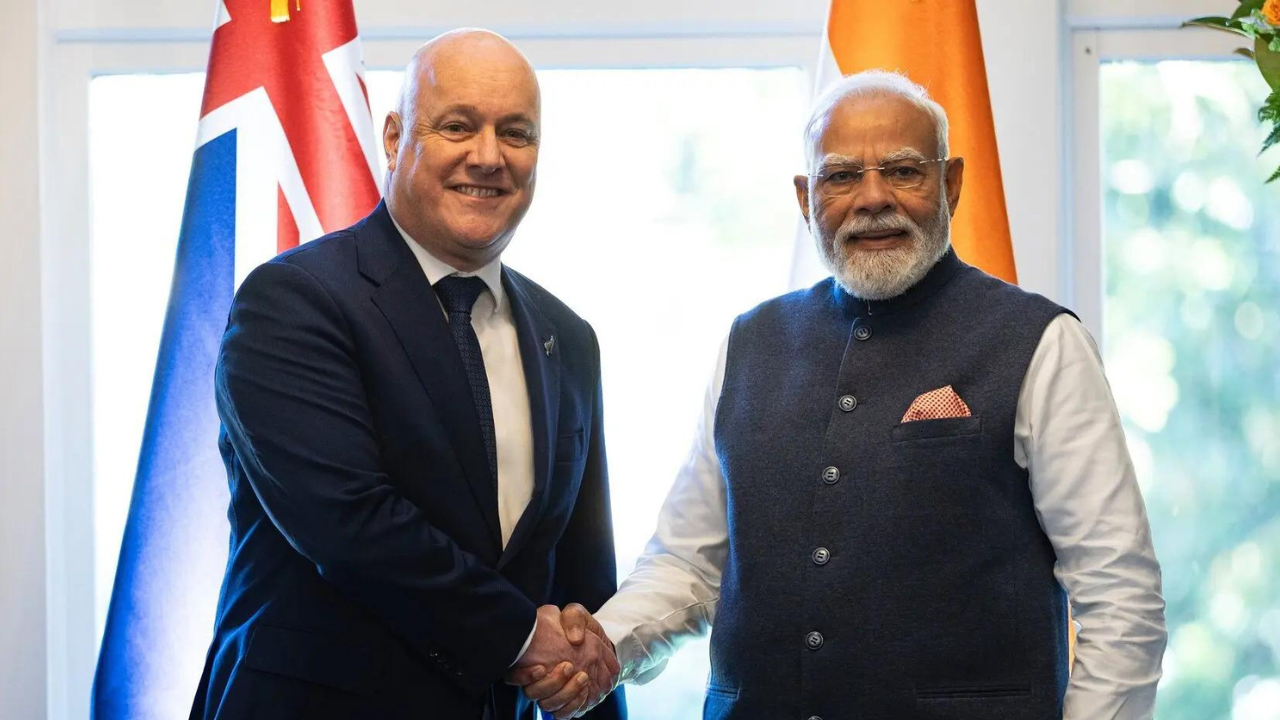
India and New Zealand have upgraded their bilateral relationship to a strategic partnership, following a summit meeting between Prime Minister Narendra Modi and his New Zealand counterpart Christopher Luxon. The leaders signed several agreements, including defence pacts aimed at enhancing maritime cooperation in the Indo-Pacific region, reciprocal logistics support between the Indian Navy and the New Zealand Defence Force, and strengthened hydrographic collaboration.
The summit resulted in 18 agreements and announcements, covering a wide range of areas. Key among them was the establishment of a joint working group to combat terrorism and a joint action plan for high-performance sports cooperation, expanding ties beyond the traditional focus on cricket. Prime Minister Modi described the two nations as 'natural partners' that are 'made for each other'.
Both leaders called for doubling bilateral trade within five years to Rs 35,000 crore, underpinned by a newly signed free trade agreement (FTA). Modi welcomed New Zealand's commitment to invest $20 billion in India over the next 15 years, a significant outcome of the trade pact. Luxon clarified that the FTA includes a 'commitment to promote' private investment, emphasizing mutual investment flows.
The strategic partnership is expected to enhance cooperation in trade, defence, maritime security, tourism, culture, sports, and multilateral issues. A 'Roadmap to 2030' was adopted to guide structured implementation of the agenda across ministries and stakeholders over the next four years.
Modi stated that shared democratic values provide a natural comfort for collaboration, adding that the FTA will open new doors for industries, farmers, and youth. He noted that cooperation between India and New Zealand is vital for peace, stability, and security in the Indo-Pacific, and that growing defence ties reflect deep strategic trust.
The leaders strongly condemned cross-border terrorism, the Pahalgam terrorist attack, and the Red Fort terror incident in a joint statement. New Zealand backed India's zero-tolerance policy against terrorism. The joint working group on terrorism will facilitate information exchange, including regarding Khalistan separatists active abroad.
On education, the leaders recognized it as a 'central pillar' of the relationship, supporting people-to-people ties, skills development, and research collaboration. Modi invited New Zealand universities to open campuses in India. Regarding concerns over high visa rejection rates for Indian students, MEA Secretary (East) Rudrendra Tandon noted that while visa policy is a sovereign matter, high rejection rates represent a 'loss of opportunity' for building the relationship.
On regional and global issues, the joint statement expressed concern over renewed escalation in West Asia, calling for restraint, de-escalation, and civilian protection. It also urged full restoration of freedom of navigation.