IAF Chief To US Commander: 'You Don't Even Let Us Go Near' The F-35
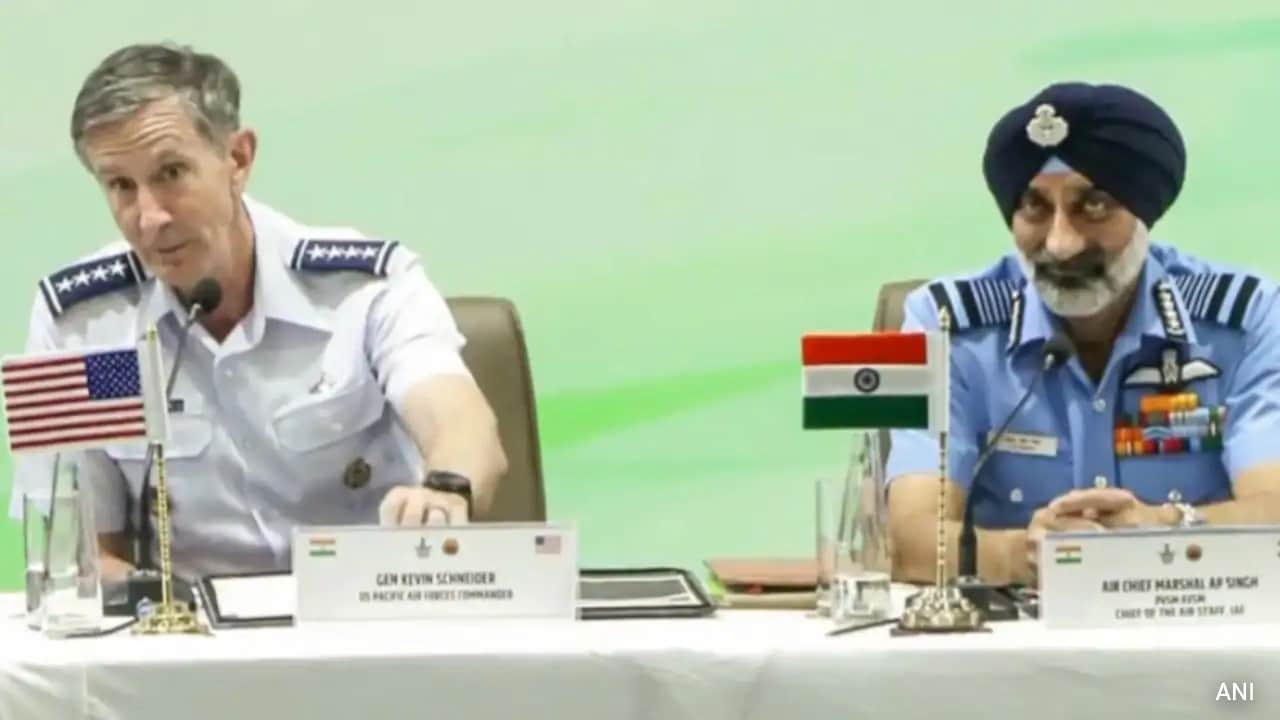
Indian Air Force Chief Air Chief Marshal A P Singh has publicly underscored the limits of defence technology sharing between India and the United States, noting that American personnel do not permit Indian officials to get close to the F-35 stealth fighter.
He was speaking at a press conference in Jodhpur, sharing the stage with General Kevin Schneider, Commander of the United States Pacific Air Forces, on the sidelines of the closing ceremony of the multinational air exercise Tarang Shakti-2026.
Asked whether the United States had made a formal offer to sell India the fifth-generation F-35, Air Chief Marshal Singh said: "Your people don't even let us go near the aircraft, and you are talking about selling it to us."
Six US Air Force F-35 Lightning II jets took part in Tarang Shakti, marking their first appearance at the exercise, which brings together air forces from several countries.
Asked how much access India had been given, the IAF chief said, "The US did not show us the cockpit, but allowed us to fly in close formation." He added that this is how countries protect sensitive military technologies — describing established practice rather than an unusual restriction.
General Schneider said decisions on sharing information about the F-35 were not his to make. "There are programme-level security classification guides that determine what we are able to share, when we share it, as well as how we protect it," he said.
Air Chief Marshal Singh also confirmed that Russia has offered its Su-57 fifth-generation fighter jets to India. "Yes, the Russians have offered. But there has been no decision yet," he told reporters. India is examining an interim fifth-generation option while its indigenous Advanced Medium Combat Aircraft (AMCA) remains years away from induction.
The deliberations come against the backdrop of China expanding its own stealth fleet, which includes the J-20 and the newer J-35. Beijing is also expected to supply 40 J-35s to Pakistan, although deliveries have not begun.
Any such induction would matter to India, whose radar, sensor and intelligence infrastructure is largely oriented towards its western front. A purchase of a fifth-generation jet, however, involves far more than the aircraft itself — technology access, integration with existing systems, weapons, maintenance and questions of long-term strategic dependence are all part of the decision.
What sets fifth-generation fighters apart is a combination of two things: they are hard to detect, and they are built to see a great deal around them.
Their shape, special coatings and internally carried weapons make them difficult for enemy radar to pick up. That is stealth. The second element is the aircraft's sensor suite — radar, electronic warfare systems and heat-seeking sensors feeding into a single live picture of the battlespace. Rather than piecing together scattered signals across multiple displays, the pilot receives a consolidated view of what is around the aircraft and can concentrate on the mission.
For India, the central question is how to acquire such a capability in the near term, while the homegrown AMCA is still some years from induction, without abandoning its longer-term objective of designing and building advanced combat aircraft itself.







