Gen Alpha protests mirror official data: India's schools missing teachers, toilets and roads
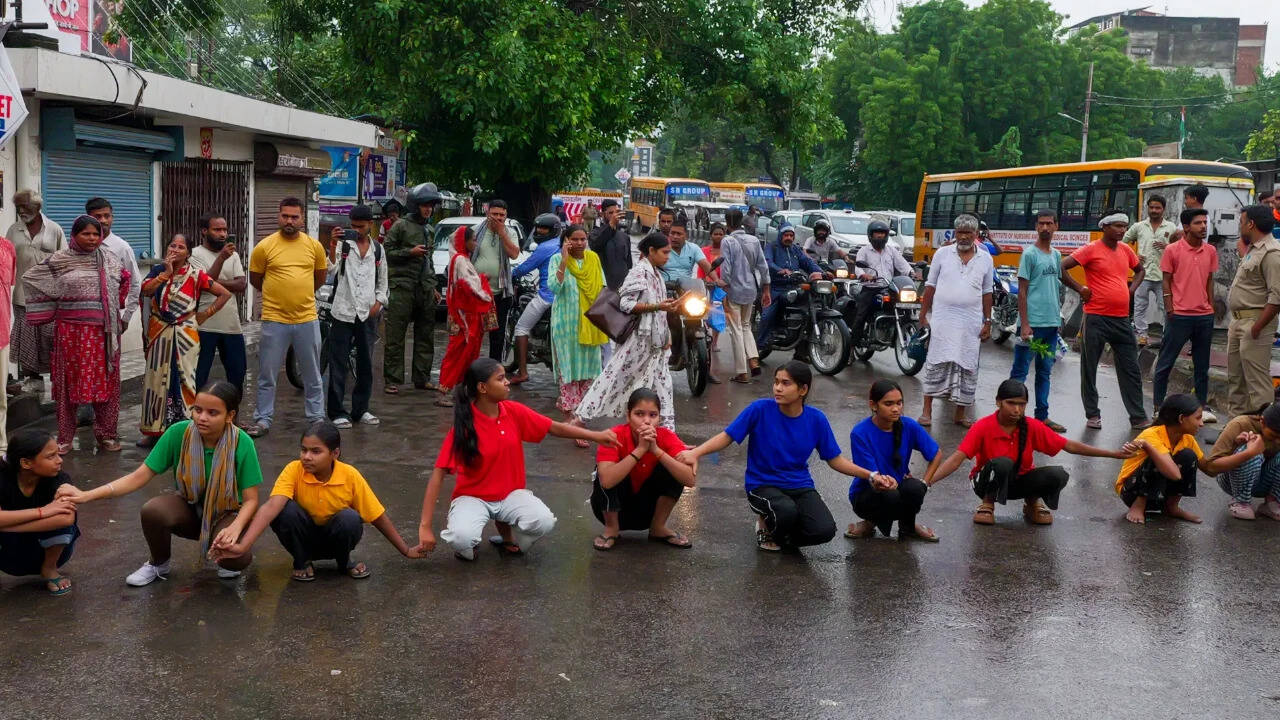
Across India, a new wave of student protests is emerging on social media — not for political causes, but for basic necessities: a teacher in the classroom, a usable toilet, a safe playground, and sometimes even a proper road to reach school. While each protest is local, the underlying problems are national in scope, as official data from the Unified District Information System for Education Plus (UDISE+) shows.
In Hamirpur, Uttar Pradesh, around 300 children marched six kilometres to the district collectorate demanding a passable road to their school. In Lucknow, 250 girls protested against teacher shortages and the lack of basic amenities. In Jaipur, students with disabilities raised concerns about inaccessible toilets, poor sanitation, and unsafe classrooms.
These are not isolated incidents. The UDISE+ report, which covers over 14.66 lakh schools and 24.7 crore students, reveals sharp regional and administrative disparities. For instance, Jharkhand has 36 students per teacher, while West Bengal has internet connectivity in only 19.7% of its schools. In Meghalaya, just 6.3% of schools have toilets designed for children with special needs.
Karnataka reports 8,042 single-teacher schools, which is 10.8% of its total schools. Kerala, despite having internet in 92.6% of schools and functional computers in 99.1%, still has 68 schools with no enrolled students at all. Tamil Nadu provides internet in 99% of its schools, but digital libraries exist in only 0.8% of state government schools.
The data also highlights the uneven distribution of school management. State governments run 68.4% of India's schools, while private unaided institutions manage 23.3%. Of the total 14,66,682 schools, 10,03,051 are state government-run, 2,194 are central government schools, 3,41,689 are private unaided recognised schools, and 79,261 are government-aided.
Teacher deployment remains one of the most glaring contrasts. UDISE+ records over 29 lakh students in 1,00,843 single-teacher schools. At the same time, there are 20,667 teachers in 5,663 schools with zero enrolment. This indicates that while some schools are severely understaffed, others are redundant.
Basic infrastructure is also lacking nationwide. Only 67.4% of schools have internet access, and 63.1% have functional computers. Digital libraries are available in just 7.1% of schools. Playground coverage is at 81.9%. For children with special needs, only 40.1% of schools have friendly toilets, 79.7% have ramps, and 58.2% have ramps with handrails.
There is also a notable divide between government and private schools. For functional girls' toilets, state government schools achieve 95.3% coverage, slightly behind private unaided schools at 96.9%. However, for toilets for children with special needs, the gap widens: 35.6% in state schools versus 44.7% in private schools. Private schools are ahead on internet connectivity (79.2% versus 63.1%) and functional computers (74% versus 59.4%). But government schools lead on accessibility: 88.2% have ramps, compared to 60.4% in private schools, and 66.9% have handrails on ramps versus 36.8%.
These figures are not just statistics. They represent the daily reality for millions of children. The Right to Education Act guarantees free and compulsory education, but without adequate infrastructure and teachers, the quality of that education remains compromised. The student protests are a reminder that the promise of education is incomplete if schools cannot provide even the most basic facilities.
The UDISE+ report serves as a crucial evidence base for policymakers. It shows where investments are needed urgently and where resources are being underutilised. As the protests demonstrate, children are aware of these gaps and are demanding their constitutional right to a dignified learning environment.







