Floating Solar: Can India's New 5,000 MW Plan Boost Renewables?
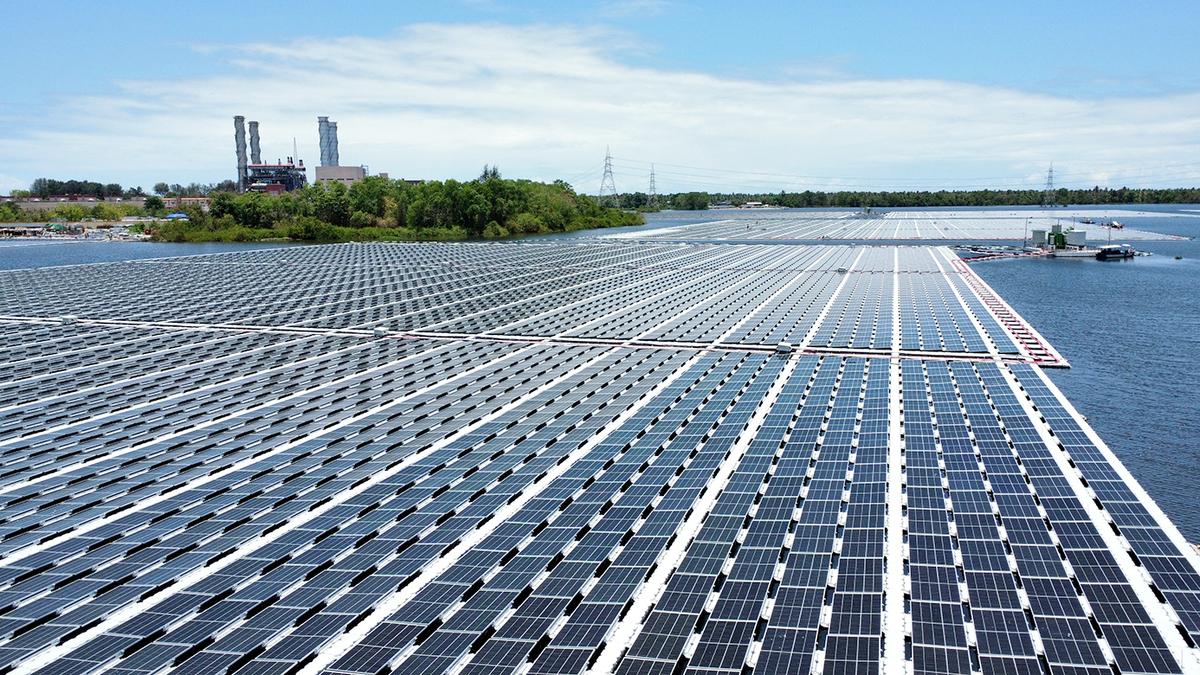
The Union Cabinet has cleared the Pradhan Mantri Surya Sarovar Yojana (PM-SSY), a central-sector scheme to build 5,000 MW of floating solar photovoltaic (FSPV) capacity on the country’s reservoirs and waterbodies. The scheme has a total outlay of ₹5,070 crore and offers Central Financial Assistance (CFA) of up to ₹1 crore per MW, released only after a plant is commissioned. Each project must be paired with an energy storage system of at least two hours, collectively 10,000 MWh, enabling states to use stored power during peak demand.
The Solar Energy Corporation of India (SECI) will implement the scheme, which the government expects to attract about ₹28,500 crore in investment. India currently has an installed floating solar capacity of about 0.7 GW against a potential of 102 GW, according to the Ministry of New and Renewable Energy’s estimates.
Floating solar plants are solar arrays that float on water surfaces such as reservoirs, irrigation tanks, industrial ponds, or hydropower lakes. Modular blocks of panels are assembled onshore, floated out, and held in place by anchors and mooring lines designed to withstand wind, waves, and changing water levels. Inverters sit on the floats or on the bank, with cables running over the floats to a substation.
India already has close to 100 GW of solar capacity and often has to curtail output. The constraint, however, is not sunlight but suitable land. A June 2026 potential assessment by the National Institute of Solar Energy (NISE) — the technical arm of the Ministry of New and Renewable Energy — identifies land availability as the critical bottleneck, especially where farming, cities, and forests compete for the same ground. Floating solar sidesteps this problem by using water surfaces that states already own. It also spreads generation to states that may not be rich in renewable resources but have large reservoirs.
Because every plant must include storage, its electricity can be shifted to the evening peak rather than being dumped at midday. This helps address the 'curtailment problem,' which refers to solar power output being intentionally suppressed when there is insufficient battery storage, often to keep thermal plants running and the grid stable.
The land question is particularly pressing for utility-scale solar, which requires large, contiguous parcels. Land acquisition has grown slower and more contested as prime sites fill up, triggering disputes over compensation, displacement, and change of land use, and competing with agriculture. Floating solar avoids most of these issues, as it needs land only for cabling to evacuate power to the grid.
To de-risk a technology that many states have little experience with, the Centre is funding feasibility studies. The scheme offers advance CFA of up to ₹30 lakh, rising to ₹50 lakh per site, for bathymetry and hydrography surveys, studies of the waterbody’s ecology, and a detailed solar-yield assessment. The feasibility report is due within nine months. This upfront financial and technical support is meant to encourage state governments to come forward with projects.
In terms of operation, floating plants convert sunlight to electricity exactly like land-based arrays; the difference lies in the flotation-and-mooring system beneath them. Water cooling can lift energy yield, while shading cuts evaporation and algae growth. There are trade-offs, however, which are largely mechanical. Continuous motion can wear floats, joints, and cables. The NISE report records that “occasional DC cable breakage was reported by all developers,” and flags slippery walkways and restricted monsoon access as safety concerns that demand trained crews and stringent protocols.
Globally, floating solar has moved from niche to mainstream in about a decade. By 2024, cumulative global capacity stood at roughly 9.6 GW, with 1–1.2 GW added each year across more than 500 completed projects — over 90% of them in Asia, led by China. This worldwide experience offers valuable lessons for India as it embarks on this ambitious expansion.