Faulty roads kill and disable — yet no agency or contractor has been penalised
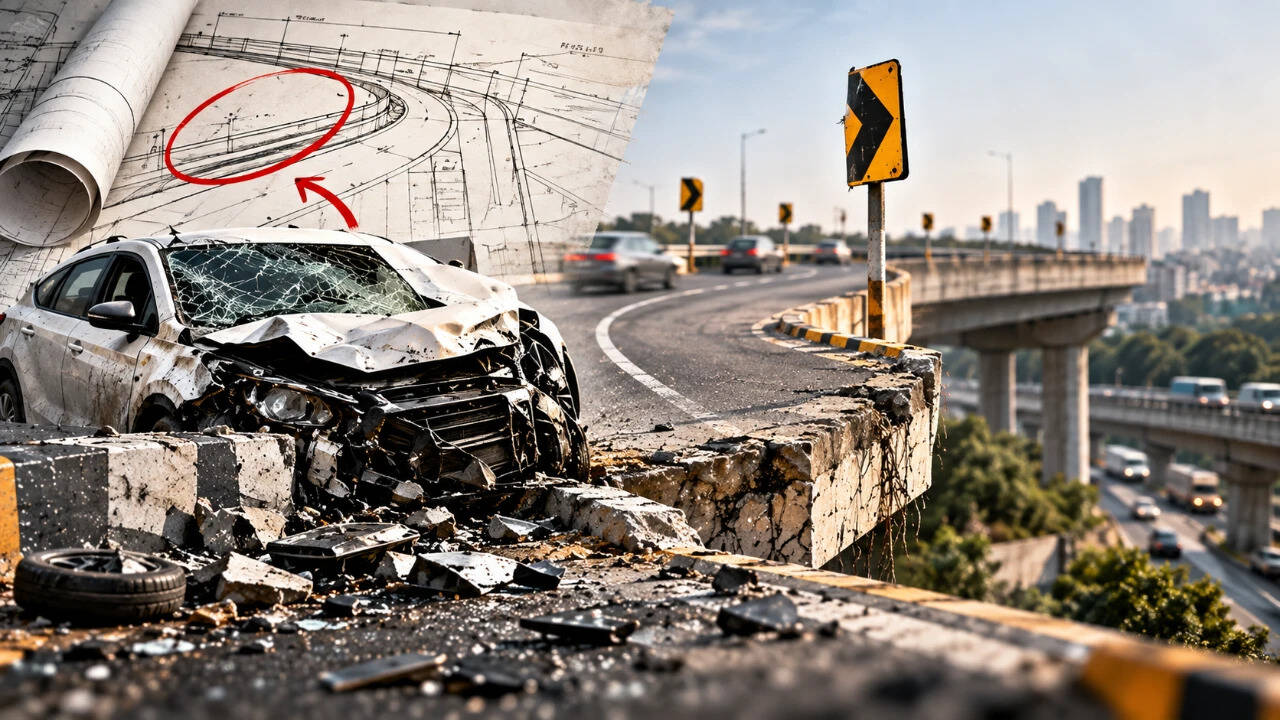
When a road crash kills or disables someone in India, the investigation usually stops at the driver. Rarely does it travel further — to the engineer who approved the alignment, the agency that failed to fix a known black spot, or the contractor who built a curve with no warning sign and no crash barrier. A Times of India report has found that this gap in accountability is almost total: no road agency and no contractor has been penalised for a death or disability caused by design failures.
The finding sits uneasily with India's road safety numbers. Official estimates put annual road crash deaths at more than 1.6 lakh, with several lakh more people injured, many of them permanently disabled. A substantial share of these crashes occur at what the government itself classifies as "black spots" — stretches with a consistently high accident record. While speeding and drunk driving are common causes, engineers and road safety researchers point to another set of factors: poor sight distance on curves, missing signage and markings, absent pedestrian crossings, badly designed junctions, and roads that leave no safe space for cyclists or two-wheeler riders.
Indian law does recognise that roads can be built badly. The Motor Vehicles (Amendment) Act, 2019 introduced provisions that allow penalties against contractors, consultants and others responsible for the design, construction or maintenance of a road if they fail to comply with prescribed safety standards. The Supreme Court Committee on Road Safety has repeatedly directed states and Union Territories to rectify black spots and to fix responsibility on officials where lapses are found. Road safety audits are, on paper, mandatory for national highway projects.
Yet the reported outcome suggests these instruments remain largely unused. Part of the reason lies in how crashes are recorded. First Information Reports are typically registered against drivers. Compensation claims under the Motor Vehicles Act are pursued against owners and insurers, not the authorities that built the road. Engineers and contractors are, in effect, not parties to the case.
There are institutional reasons as well. The agency that builds a road is often the same one expected to investigate why it failed; state public works departments and highway authorities are rarely eager to indict their own staff. Penal action against a contractor can also entangle the government in arbitration and delay payments on other projects — a cost that departments are reluctant to bear. Prosecution requires evidence that a design standard was breached, which demands technical investigation capacity that few districts possess.
For victims, the practical consequence is that the hazard often survives the crash. Black spots identified years ago continue to record fresh fatalities, sometimes with only cosmetic changes — a fresh coat of paint, a rumble strip, a signboard — rather than the geometric redesign that the location needs. Road safety advocates argue that this is where accountability has its clearest effect: when a design failure carries a cost for the agency or the firm that caused it, fixing it becomes a priority rather than an option.
None of this is to suggest that drivers bear no responsibility. Human error is a factor in the majority of crashes, and enforcement of speed limits, helmet and seat-belt rules remains weak in many states. But the two explanations are not competing. A driver who misjudges a curve is far more likely to survive it if the curve is designed for the speed at which people actually drive, if there is a barrier, and if an ambulance can reach the spot in time.
The question the report raises is a straightforward one. India counts its road deaths with increasing precision, publishes black spot lists, and has a legal provision specifically aimed at faulty road construction. What it has not done is apply that provision. Until it does, road safety policy will continue to place the entire burden of a fatal mistake on the person behind the wheel — and almost none on the road beneath it.







