Dharma is not just rituals or food, says RSS chief Bhagwat: 'It stands on four pillars'
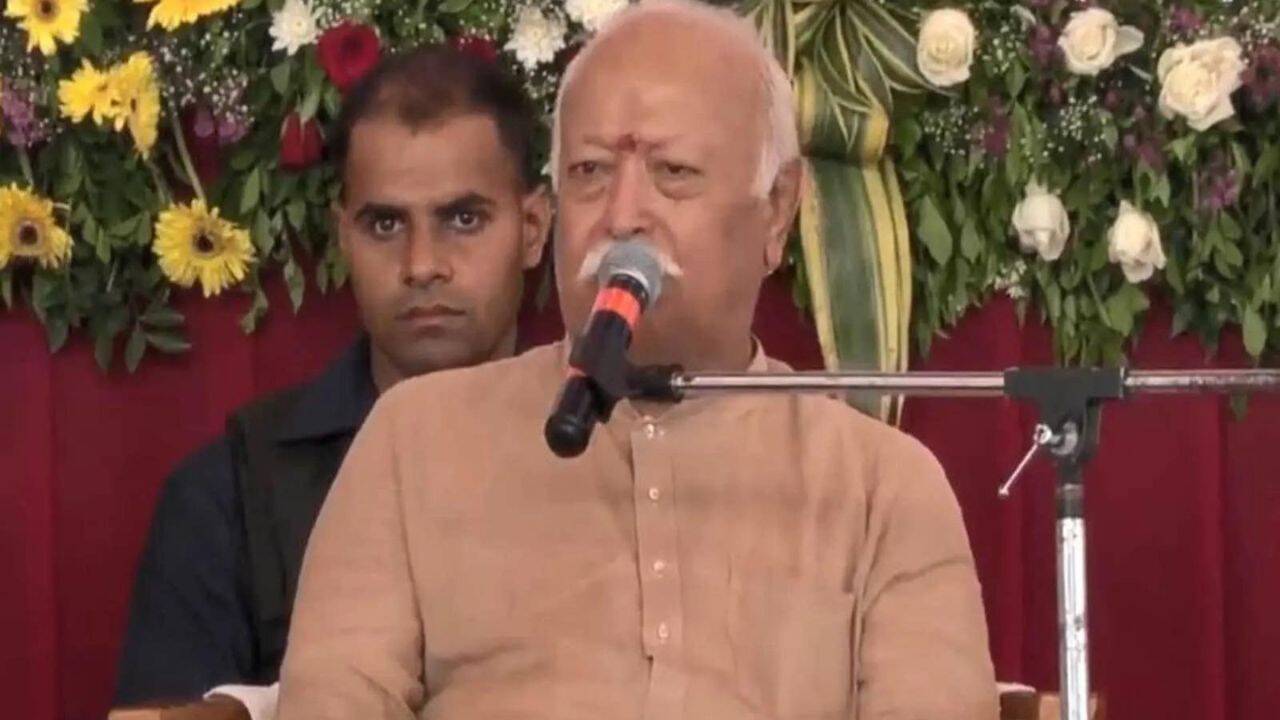
Rashtriya Swayamsevak Sangh (RSS) chief Mohan Bhagwat has said that dharma does not mean merely rituals, worship or eating habits, and that it "stands on four pillars". The four pillars were not spelled out in the remarks as quoted.
Mr Bhagwat argued that the word has been narrowed in everyday use to a set of practices, when it in fact denotes a wider principle governing duty, conduct and social order.
The Sanskrit term "dharma" is commonly translated as religion, but its older and broader meaning covers duty, righteousness, law and the moral order that holds a society together. In Indian philosophical traditions it is discussed less as a set of beliefs to be professed than as a set of obligations to be observed — towards family, community, profession and the wider world.
The image of pillars is not new. In the Mahabharata, dharma is described as a bull that stands on four legs in the first of the four ages, loses one leg in each subsequent age, and finally stands on a single leg. Commentators have read this as an observation about the weakening of ethical restraint over time rather than a literal claim about history. Mr Bhagwat's reference draws on this tradition of describing dharma as something that must be supported by specific virtues.
Mr Bhagwat has led the RSS since 2009. The organisation, founded in Nagpur in 1925, describes itself as a cultural body devoted to building character and national consciousness through its daily shakhas. It is widely regarded as the ideological parent of the Bharatiya Janata Party and of a network of affiliated organisations.
The meaning of dharma is politically charged in India. Defenders of the RSS argue that Hindutva is a cultural and civilisational identity rather than a religious creed, and that it is open to people of all faiths. Critics, including several minority religious groups and civil liberties organisations, contend that in practice this vision has been accompanied by tensions over conversion, cow protection, and dietary and dress practices, and that it treats some communities as less Indian than others.
India's Constitution guarantees freedom of conscience and the right to profess, practise and propagate religion under Articles 25 to 28. The text uses the word "religion", which official Hindi renderings translate as "dharma" — a reminder that the two terms are not exact equivalents in law or in everyday speech.
Mr Bhagwat has made similar arguments before, saying on earlier occasions that the RSS respects all faiths and that Hindutva is about culture, not worship. Such remarks are often read as an effort to distinguish the organisation's programme from narrow ritualism and to present it as an ethical and universal vision.
Statements of this kind are weighed in public life less by their philosophical framing than by the conduct of those who invoke the term. The debate over how the word should be understood — as faith, as ethics, or as cultural identity — is likely to continue.







