Chinese Humanoid Robot 'Lightning' Runs 100m in 9.32 Seconds, Faster Than Bolt's Record
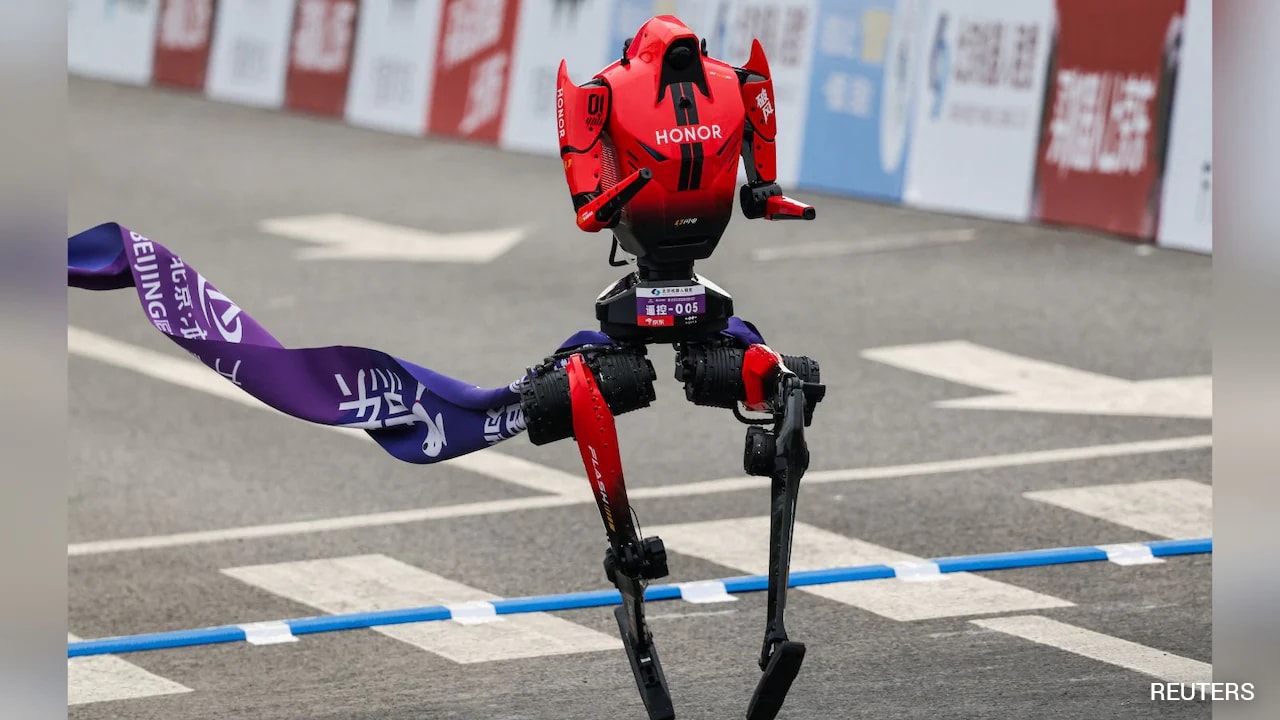
A humanoid robot developed by Chinese smartphone maker Honor has completed the 100-metre sprint in 9.32 seconds, a time faster than the human world record held by Jamaican sprinter Usain Bolt. The performance took place during a preparatory test event for the second World Humanoid Robot Games, which opened in Beijing on Saturday.
The robot, named Lightning, reached a peak speed of 14.5 metres per second, according to China's state broadcaster. It surpassed the 9.58-second mark set by Bolt at the 2009 World Athletics Championships in Berlin. However, sports officials and robotics experts note that the comparison is not direct, as Lightning is a machine designed for speed, not a human athlete.
Lightning had earlier won the 21-km Beijing half marathon in April with a time of 50 minutes and 26 seconds, a pace faster than the elite men's human world record for that distance. At the time, the robot stood 169 cm tall and had 95-cm legs. Researchers have since lengthened its legs by 10 cm to 1.05 metres ahead of the World Humanoid Robot Games, China Central Television reported.
China has been promoting humanoid robots as a strategic emerging industry. Policymakers and technology companies believe that advances in artificial intelligence and hardware will accelerate the deployment of such robots in manufacturing, logistics, and consumer applications. The World Humanoid Robot Games serve as a platform to showcase these innovations and test their capabilities in real-world scenarios.
The event highlights the rapid progress in robotics engineering, particularly in China, where government support and private investment have fuelled development. While Lightning's speed is an impressive technical achievement, experts caution that humanoid robots still face significant challenges in achieving the agility, balance, and energy efficiency of human movement outside controlled environments.
Lightning's performance is nonetheless a milestone in the field, demonstrating that humanoid machines can achieve feats once thought exclusive to biological athletes. As the World Humanoid Robot Games continue, they are expected to draw attention to both the potential and the limitations of current robotic technology.







