China develops hypersonic missiles capable of targeting aircraft far from shore, report says
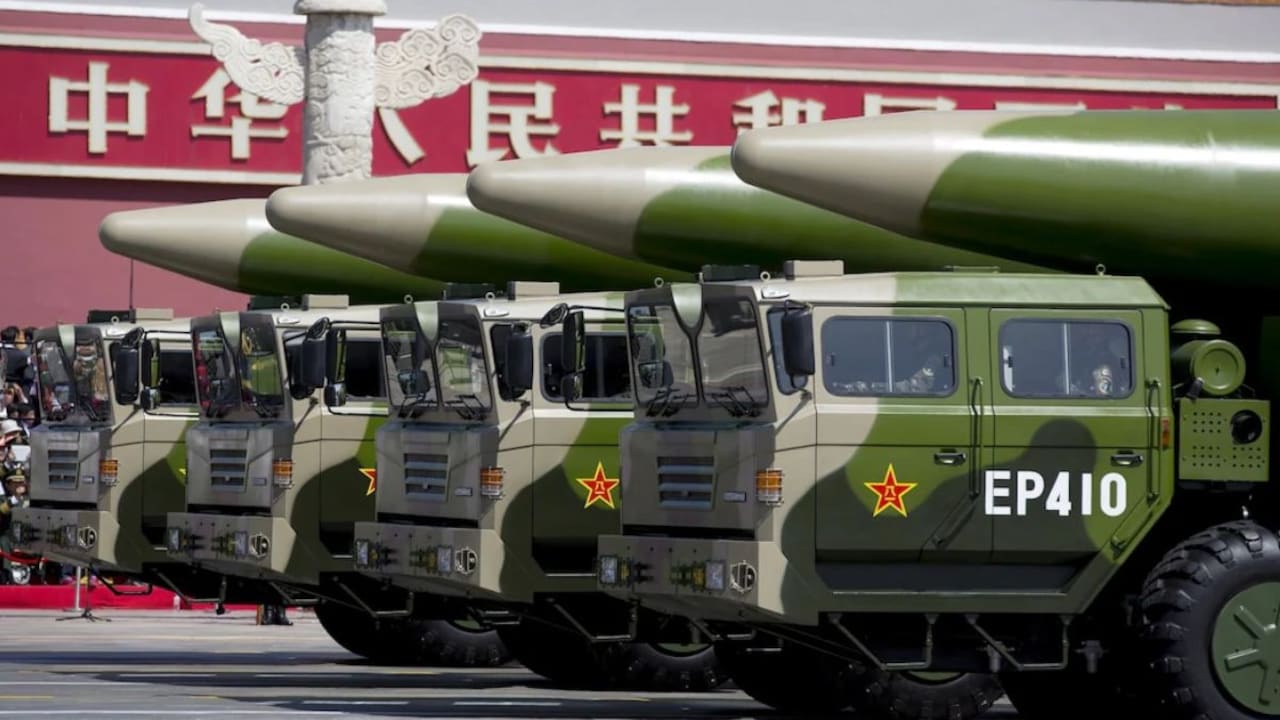
China has developed hypersonic glide vehicles that can launch air-to-air weapons targeting high-value aircraft such as refuelling tankers, airborne early-warning and control aircraft, and flying command posts, according to a report by Bloomberg citing a person with direct knowledge of the matter.
The development comes at a time when the United States is facing shortages of crucial air defence missiles and long-range strike weapons following six months of war with Iran, the report noted.
A hypersonic glide vehicle (HGV) is a warhead that can manoeuvre in the atmosphere at hypersonic speeds after being launched by a missile. This ability to change course on its way to a target extends the weapon's range and makes interception significantly more difficult.
According to the Bloomberg report, China is the only country publicly known to operate and develop HGVs capable of launching air-to-air missiles. The Chinese military has also added air-to-air capabilities to some hypersonic cruise missiles and built anti-ship capabilities into several types of missiles.
An HGV deployed from China's DF-17 missile could travel about 2,414 kilometres, which is slightly short of the distance from China to the US territory of Guam, a major military site in the western Pacific. China's more advanced DF-27 missile has an estimated maximum range of about 8,000 kilometres, potentially putting targets as far away as Hawaii within range.
However, using a weapon derived from a ballistic missile to attack a distant aircraft is costly, difficult and risky. A ballistic missile travelling at maximum range could take 20 minutes or more to reach its target, requiring highly accurate and continuously updated targeting information. That long “kill chain” of getting distant sensor information to the missile makes operations easier to disrupt, the report said.
There is also a risk that an attack using a ballistic missile could be mistaken for a nuclear strike. This so-called discrimination problem complicates the weapon's use, especially during an all-out war, when it may inadvertently provoke a nuclear response, according to Bloomberg.
Despite these challenges, China appears to be accelerating its missile development. In a 2026 report, the US Air Force's China Aerospace Studies Institute noted that China's missile modernisation efforts are “increasingly” prioritising the “ability to inflict coordinated, system-level damage across an adversary's operational architecture.”
In May, Bloomberg reported that China's missile production has increased in 2025 at its fastest pace since President Xi Jinping took office in 2013. According to Pentagon estimates, as of 2024, China has at least 3,150 ballistic missiles and 300 ground-launched cruise missiles, representing increases of 147 per cent and 50 per cent, respectively, from 2015, when the US started disclosing such estimates.
Long-range air-to-air weapons are considered key to any future conflict. The US has developed the AIM-174B from its RTX Corp. SM-6 air defence missile; its exact range is classified, but the ground-launched SM-6 has a range of 250 miles or more. On Saturday, the US Navy said it was testing the AIM-424 Malice air-to-air missile from RTX unit Raytheon Co., which it said had a range of more than 300 kilometres.