BRICS summit day 2: Modi, Putin and Xi join world leaders for family photo at Bharat Mandapam
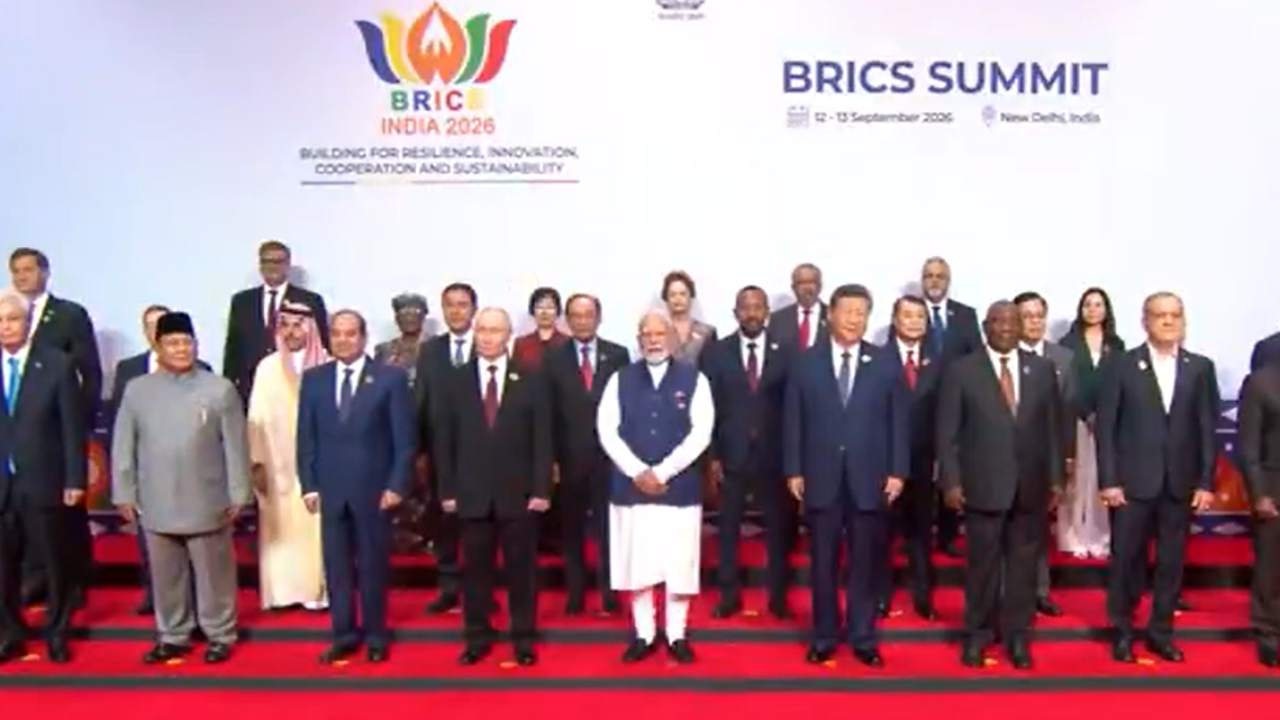
Leaders of the BRICS grouping assembled at Bharat Mandapam in New Delhi on the second day of the summit for the traditional “family photo”, the group portrait that has become a fixed ritual at gatherings of heads of state and government.
Prime Minister Narendra Modi was joined by Russian President Vladimir Putin, Chinese President Xi Jinping and other leaders attending the summit at the convention centre in the capital, which earlier hosted the G20 Leaders’ Summit in 2023.
The family photograph is more than a photo opportunity. At multilateral summits it is a carefully choreographed moment, with standing positions, seating and the order in which leaders walk on to the stage often read as quiet signals about proximity, protocol and the state of relations between countries. Officials usually spend considerable time on the arrangement so that no delegation reads the final composition as a slight.
For the host, the photograph also serves as a visual record of who turned up — an important point in a grouping where attendance itself can carry diplomatic meaning.
BRICS began as an informal coalition of four fast-growing economies — Brazil, Russia, India and China — and became a formal grouping with the addition of South Africa in 2010. In recent years it has widened further, admitting new members from Asia, Africa and West Asia. Taken together, the member countries account for a large share of the world’s population and of global economic output, which is central to the grouping’s claim to speak for the developing world.
The summit agenda typically covers reform of international financial institutions, greater use of local currencies in trade, development finance through the New Development Bank, and cooperation on climate change, health, food security and counter-terrorism. Discussions on how emerging economies should be represented in global governance have been a recurring theme.
India has used its chairmanship and hosting duties at such forums to press the case of the Global South — the countries of Asia, Africa and Latin America that often argue existing international institutions do not reflect current economic realities. New Delhi has also emphasised consensus-based outcomes, preferring language that all members can accept over sharper declarations that risk splitting the grouping.
The second day of a summit is usually when the substantive work is completed. Leaders hold plenary sessions, review the progress made by their sherpas and ministers over the preceding months, and adopt a joint declaration setting out agreed positions. The document is drafted well in advance and negotiated line by line, since any member can hold up language it disagrees with.
The margins of the summit are often as closely watched as the main sessions. Bilateral meetings between leaders on the sidelines allow countries to discuss issues that fall outside the formal agenda, and the schedule of such meetings is often disclosed only at short notice.
What emerges from the gathering will be judged largely by the final declaration — the points on which members could agree, and the subjects on which they chose to say little. For now, the day’s images from Bharat Mandapam place the leaders of some of the world’s largest economies in a single frame, a reminder of the grouping’s ambition to reshape how global decisions are made.