BRICS in Delhi: Modi, Xi and Putin Share Stage as Summit Adopts New Delhi Declaration
Leaders of the BRICS grouping met at Bharat Mandapam in New Delhi for the 18th BRICS Summit, which concluded with the unanimous adoption of the New Delhi Declaration 2026. The declaration reaffirms the members' commitment to multilateralism, the peaceful resolution of conflicts and closer cooperation among countries of the Global South.
The grouping comprises Brazil, China, Egypt, Ethiopia, India, Indonesia, Iran, Russia, Saudi Arabia, South Africa and the United Arab Emirates, according to the summit's official listing. India is hosting the meeting, the 18th since the grouping's first summit in 2009.
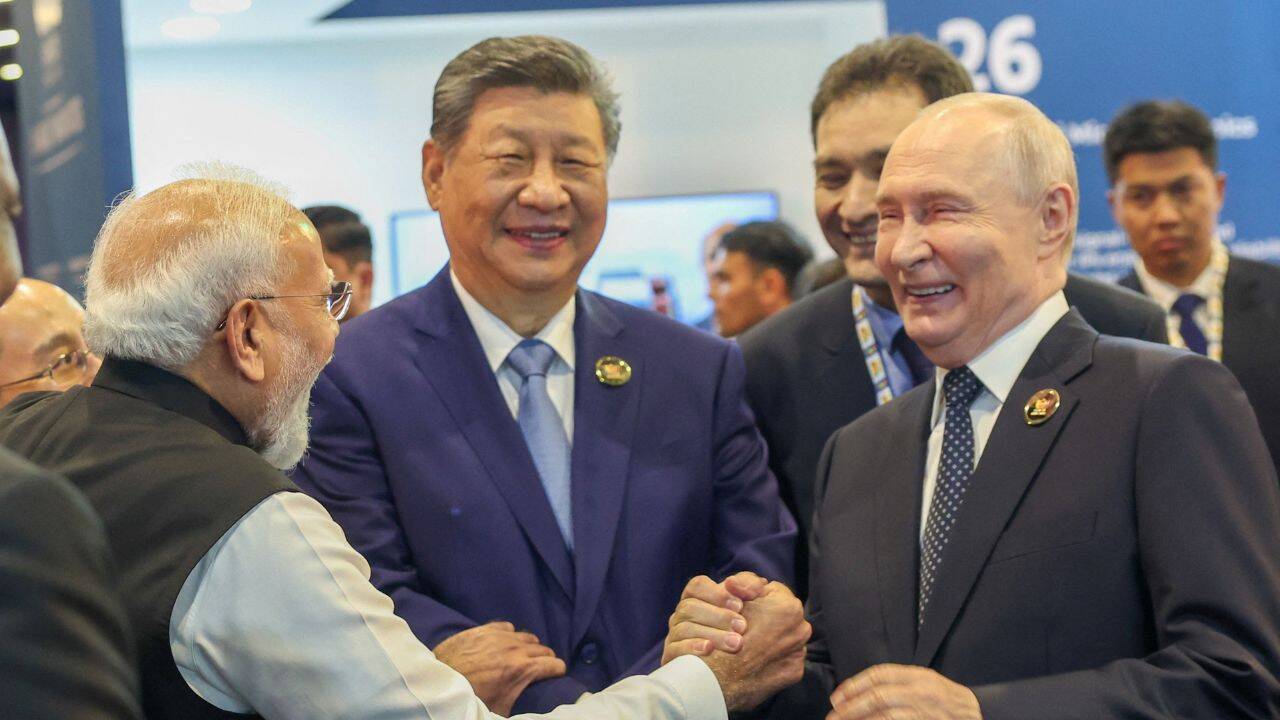
Photographs released from the summit show Prime Minister Narendra Modi posing for a group photograph with Chinese President Xi Jinping, Russian President Vladimir Putin and representatives of the other member countries. In one photograph, Modi is seen holding hands with Xi and Putin as the three leaders pose together. In another, he walks alongside fellow leaders at Bharat Mandapam, the convention complex that also hosted the G20 Leaders' Summit in 2023.
Modi and Putin walked together along a red carpet at the BRICS Business Forum 2026, held on the sidelines of the summit. After a bilateral meeting on the margins of the main event, the two leaders travelled in the same car at Bharat Mandapam.
At the Business Forum, Modi was also seen walking alongside Putin, Iranian President Masoud Pezeshkian and South African President Cyril Ramaphosa. Business forums of this kind are a regular feature of the summit calendar, bringing together governments and industry representatives from member states.
Modi, Xi, Putin and other leaders planted a banyan tree in Delhi. The summit described the plantation as a symbol of BRICS' deep roots, its growing strength and a shared commitment to a common future.
Addressing the gathering, Modi called for a more inclusive global order and a greater role for the Global South — a phrase used in international diplomacy to describe developing countries across Asia, Africa and Latin America. The New Delhi Declaration 2026, adopted unanimously at the close of the summit, reaffirms the members' commitment to multilateralism, peaceful conflict resolution and stronger cooperation among Global South nations.
BRICS began as a four-member grouping of Brazil, Russia, India and China, with South Africa joining in 2010. It has expanded in stages since then, with new members admitted in recent years. The enlargement has increased the grouping's combined share of the world's population and economic output, while also raising practical questions about how quickly eleven members can reach consensus on contentious international issues.
As is customary, the summit included both plenary sessions and a series of bilateral meetings between leaders on the sidelines. The public outcomes announced at the close of the meeting centred on the declaration and the statements delivered during the sessions.
This report is based on the official photo feature released from the summit and the captions accompanying it. The images document the ceremonial moments of the three-day meeting — the group photograph, the walk-throughs, the tree plantation and the bilaterals — rather than its closed-door negotiations.
In the words of the summit's own framing, the gathering was an occasion to reaffirm cooperation among member states and their partners in the Global South. What follows from that, in terms of concrete commitments, will become clear in the months ahead as the declaration's provisions are taken forward by member governments.