Beyond Chatbots: How AI Is Solving India's Real-World Problems
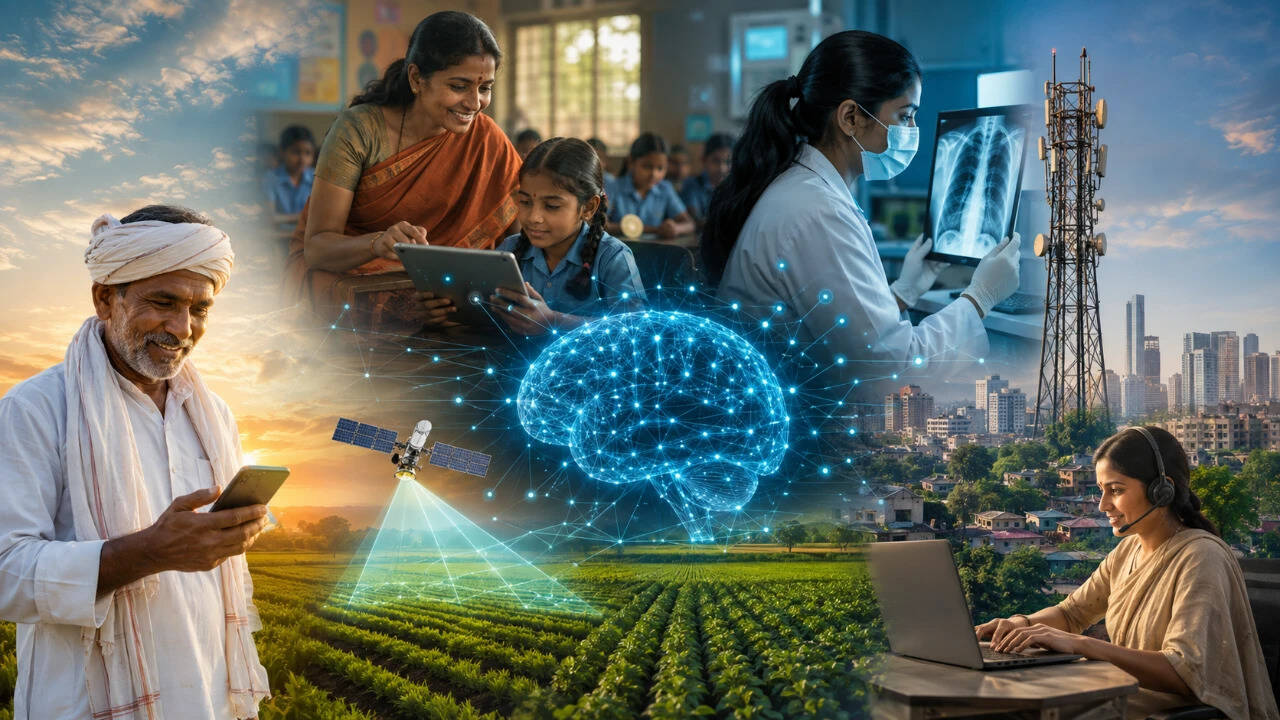
Artificial intelligence is often associated with chatbots, coding assistants, and workplace efficiency. But across India, a quieter revolution is unfolding. Governments, technology companies, startups, nonprofits, and research organisations are collaborating to deploy AI in ways that reach millions, not just a handful of users. These efforts are targeting some of the country's most persistent development challenges, from climate-resilient farming to inclusive education and affordable healthcare.
India's digital economy is already a significant contributor to national output. According to the Ministry of Electronics and Information Technology (MeitY), the digital economy contributed Rs 31.6 lakh crore, or 11.7% of the GDP, in 2022-23. By 2030, this share is expected to approach one-fifth of the economy. AI is increasingly becoming a part of this growth story, with practical applications emerging in sectors that directly affect ordinary citizens.
Education offers one of the clearest examples. Microsoft's Shiksha Copilot, developed with the Shikshana Foundation using Azure OpenAI Service, is helping around 1,000 teachers prepare localised lesson plans for nearly 30,000 children across 750 government schools in Karnataka. Tasks that once took hours can now be completed in about 10 minutes. The programme is expected to expand to another 8,000 teachers across Karnataka and Telangana. Microsoft has also announced a larger commitment to train 10 million Indians in AI by 2030, after achieving its earlier target of skilling 2 million people ahead of schedule.
Agriculture is another major area of impact. Farmers increasingly face unpredictable rainfall, pest outbreaks, and rising temperatures, while agricultural extension services remain stretched. AI-powered advisory platforms are helping bridge that gap. Farmer.Chat, developed by Digital Green, provides advice through voice, text, images, and videos in local languages. It offers recommendations tailored to crops, soils, weather, and local conditions. The platform reportedly expanded from 15,000 to 250,000 Indian users within a year, while costing less than $1 per farmer annually. Digital Green also says it has reduced the cost of introducing a new farming practice from $35 to under $1 by using AI-driven advisory systems.
Nonprofit institute Wadhwani AI works at a larger systems level. Its AI tools are now reported to have reached more than 190 million people. The organisation says its solutions have helped prioritise over 35,000 villages for tuberculosis screening, supported nearly 2.7 lakh teachers, delivered personalised learning support to 7.9 million students, and resolved more than 5 million agricultural grievances.
Healthcare is seeing practical applications as well. Startup Qure.ai has developed an AI system that analyses chest X-rays for tuberculosis. A Health Technology Assessment by the Indian Institute of Public Health Gandhinagar reportedly found the technology to be more cost-effective than conventional screening pathways. This could be significant in a country that accounts for nearly 28% of the world's new tuberculosis cases.
Language is another barrier that AI is beginning to address. Platforms such as Bhashini aim to make government services accessible in more than 22 Indian languages. AI-powered translation is already being used for grievance redressal, Aadhaar transliteration, railway enquiries, and several citizen services, reducing dependence on English or Hindi and making digital governance more inclusive.
Climate resilience is becoming another area of rapid innovation. SatSure combines AI with satellite imagery to help banks assess agricultural loans, monitor crop health, and predict yields. Such tools enable financial institutions to make better decisions while helping farmers access credit more easily.
These examples illustrate a broader trend: AI is moving beyond the hype and into practical, high-impact solutions. However, experts caution that scaling these initiatives requires robust data infrastructure, clear privacy safeguards, and continuous human oversight. While the potential is immense, the focus must remain on ensuring that AI serves the public good, reduces inequalities, and respects constitutional values. The next few years will determine whether India can translate these early successes into lasting, inclusive development.