Between Big Neighbours, There Will Be Issues: Jaishankar On India-China Ties
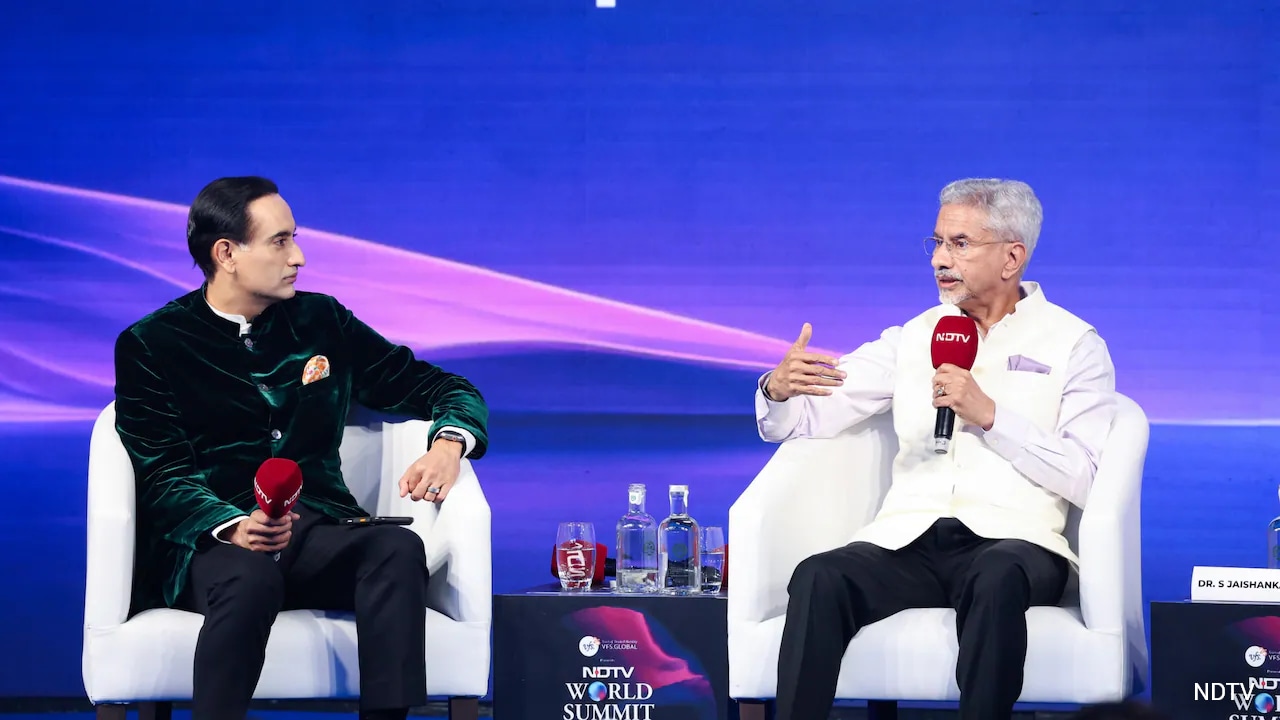
Differences between India and China are to be expected given that they are large neighbouring countries, External Affairs Minister S Jaishankar has said, while stressing that both sides recognise a workable relationship serves their national interests.
Speaking at the NDTV World Summit in New Delhi, Jaishankar said that while both countries have an interest in maintaining a functional relationship, several outstanding matters between them still need to be addressed. "Are there other issues? Yes, there are. I mean, between big countries, between big neighbours, there will be issues. So we've got to recognise that and address those issues," he said.
On the boundary dispute
Asked whether India's approach to resolving the boundary dispute with China had shifted, Jaishankar clarified that any final settlement would have to cover the entire boundary. He said there had been no change in that position, but added that discussions on specific areas could serve as a starting point for progress.
"For any settlement to happen, it will have to include the entire boundary. And I mean, it has never been any... I don't think there's a change of position in that sense. Any settlement has to be across, but any concrete discussion has to begin somewhere. There's got to be a starting point," he said.
Border peace as a guiding principle
Jaishankar said peace and tranquillity along the border had been a key principle guiding India-China relations since the 1980s. Over the decades, the two countries established multiple agreements and detailed procedures to manage border activity and prevent confrontations.
"We have had multiple agreements which were designed to reinforce the peace and tranquillity in the border areas. There were very intricate procedures worked out for what happens when you do patrolling, how much distance do you keep, who does what, how do you signal, et cetera," he said.
That framework was breached in 2020, when peace and tranquillity were disturbed in several border areas, with violence and casualties reported in Galwan. According to Jaishankar, the developments affected the wider relationship, including trade, political ties and exchanges between civil society groups.
He said restoring peace along the border had been a necessary condition before relations could move towards greater normalcy, and that the process would take time.
Both sides seek a stable relationship
The minister said India and China both recognise that maintaining a basic working relationship is in their respective national interests. He described the hostility that followed the Galwan clashes as understandable in the circumstances, but said it did not serve either country's interests.
"Both we and China are agreed that it's in our respective national interests that we have a basic ability to deal with each other and to maintain a relationship. A very hostile, acrimonious relationship such as we saw after Galwan — that was understandable after Galwan — did not serve our interests," he said.
Jaishankar added that restoring normal relations would not by itself resolve all outstanding issues, and that India and China would need to recognise and address their differences through continued engagement.
The comments come amid ongoing efforts by both countries to stabilise ties following the 2020 border standoff, with diplomatic and military-level talks continuing on the ground.