Assam CM Himanta accuses Rahul Gandhi of 'Hindu baiting' in Manusmriti remarks
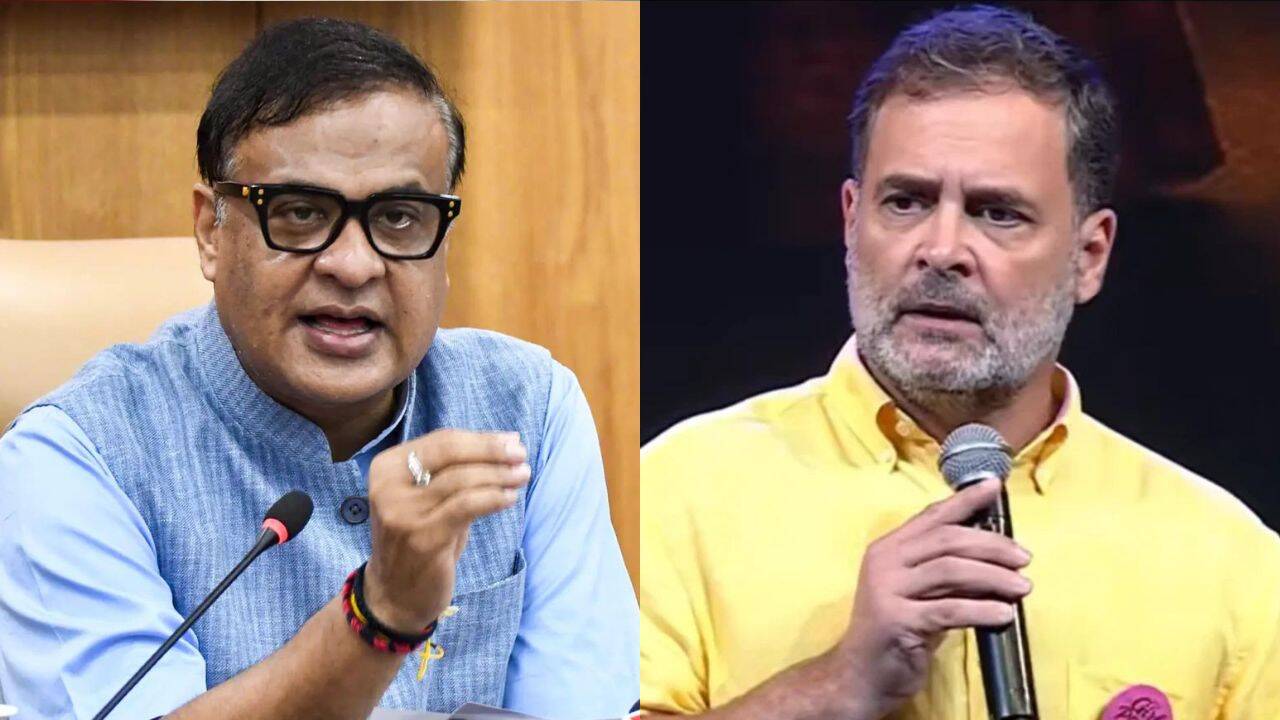
Assam Chief Minister Himanta Biswa Sarma on Wednesday criticised Congress leader Rahul Gandhi, calling him a 'Hindu baiter' over his recent remarks on the Manusmriti, an ancient Hindu legal text. The sharp exchange has ignited a fresh political row, with leaders from rival parties trading charges over the interpretation of religious scriptures and their relevance in modern India.
Speaking to reporters in Guwahati, Sarma said Gandhi's comments were part of a deliberate pattern to demean Hindu traditions and provoke outrage. "Rahul Gandhi has consistently shown disrespect towards Hindu symbols and texts. His remarks on the Manusmriti are not merely uninformed but reflect a mindset that seeks to belittle the faith of millions," the Chief Minister said.
The controversy began earlier this week when Rahul Gandhi, during a public address in Maharashtra, referred to the Manusmriti while discussing social justice and caste discrimination. Gandhi argued that certain ancient texts, including the Manusmriti, have been used historically to justify inequality and oppression. He called for a critical examination of such texts in the light of constitutional values of equality and fraternity.
The Congress leader's remarks were met with immediate backlash from BJP leaders and right-wing organisations, who accused him of distorting Hindu culture. Sarma's statement on Wednesday escalated the war of words. "Calling him a Hindu baiter is not an exaggeration. His entire political career has been built on attacking Hindu identity. The Congress party, under his leadership, has lost all moral right to speak on matters of faith," Sarma added.
In response, the Congress party defended Rahul Gandhi, stating that his comments were aimed at highlighting social injustices and not at disrespecting any religion. A party spokesperson said, "Rahul Gandhi has always respected all faiths. His remarks on the Manusmriti were contextual and intended to initiate a debate on how historical texts should be read in a modern democratic society. The BJP is deliberately twisting his words for political mileage."
The Manusmriti, composed around 200 BCE to 200 CE, is one of the many ancient Indian texts on dharma and social conduct. While it holds religious significance for some Hindus, historians and scholars point out that it also contains verses that are discriminatory towards women and lower castes. Over the centuries, many social reformers, including B.R. Ambedkar, have criticised these aspects of the text.
The political row comes at a time when religious and cultural symbols are frequently invoked in election campaigns. Observers note that such contentious debates often serve to mobilise support along communal lines. However, they also risk deepening societal divisions.
The Assam Chief Minister's strong language reflects the BJP's strategy of countering Congress's attempts to raise caste and social justice issues. Political analysts say that the ruling party at the Centre is keen to position itself as the sole guardian of Hindu interests, a space that has historically been contested by various regional and national parties.
Meanwhile, social media has been abuzz with reactions from both supporters and critics of Rahul Gandhi. Hashtags supporting and condemning him have been trending, with users sharing their interpretations of the Manusmriti and its place in contemporary Hindu society.
Efforts to reach Rahul Gandhi for a direct response were unsuccessful at the time of writing. However, in an earlier statement on social media, he had said, "I have immense respect for all religions. My only aim is to ensure that the Constitution's promise of equality is realised for every citizen. If that means questioning historical texts that perpetuate inequality, I will not hesitate."
The controversy is likely to intensify in the coming days as both parties prepare for upcoming state elections. The Congress has announced plans to raise the issue in Parliament, while the BJP has called for an apology from Rahul Gandhi. A similar controversy had erupted in 2018 when Gandhi visited a temple in Gujarat and was accused of performing rituals in a theatrical manner.
As the political battle unfolds, the broader question of how to engage with ancient texts — whether to revere them uncritically or interpret them through a constitutional lens — remains a matter of deep debate in Indian society. What is clear is that the Manusmriti row has become yet another flashpoint in the ongoing ideological clash between the country's two largest political parties.







