Activists tell Supreme Court: curbs on sharing livestreams undermine open justice
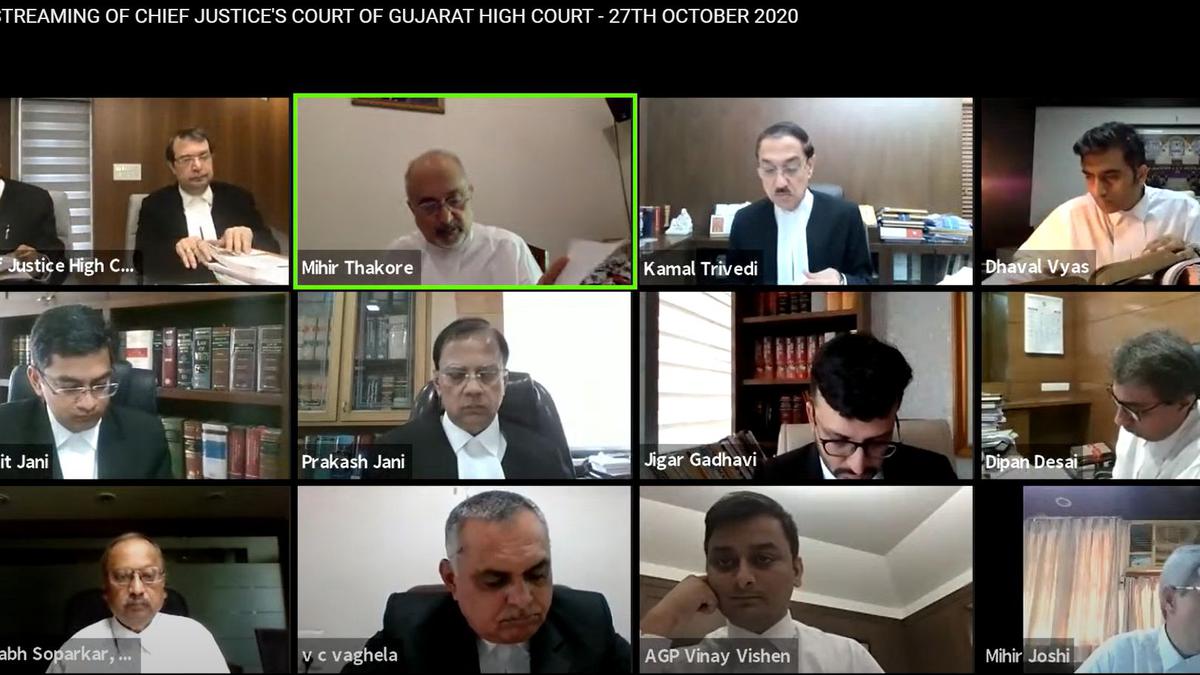
Two activists have opposed a Supreme Court order restricting the circulation of livestreamed court proceedings on social media and digital platforms, arguing that it reverses the principle of open justice upheld by the apex court itself in several judgments.
The application, filed by activists Anjali Bhardwaj and Amrita Johri through advocates Prashant Bhushan and Cheryl D'Souza, said the July 24 order veers away from the principle of open courts, which is a constitutional guarantee under Article 21 of fair, just and reasonable procedure.
“Open access to justice ensures that the judicial process remains answerable to the public and guards against arbitrariness,” the application said.
The interim order was passed by a Bench headed by Chief Justice of India Surya Kant in a petition filed by Harshita Grover. It prohibits the extraction, modification, dissemination, posting, reposting, uploading, recording, or monetisation of audio-video recordings of judicial proceedings on any social media or digital platform without prior permission of the Supreme Court Secretary General or the Registrar General of the State High Courts.
The apex court had reasoned that unregulated circulation of livestreamed proceedings could make judges, advocates, and litigants vulnerable to trolling and reputational harm, while eroding public confidence in the judicial system.
The activists, however, argue that the concern over intentional misuse or misrepresentation can be addressed more precisely by providing authorised livestreams and audio-video recordings of court proceedings and by defining the terms and conditions of reuse, sharing, and dissemination, rather than restricting these activities based on the nature of the user.
“The safeguards should be such that they protect fair and accurate representation, including sharing and dissemination of proceedings that are already open to public view,” the application said.
It contended that the July 24 order places over-reaching restrictions on sharing and dissemination of audio-visual recordings of court proceedings “without drawing a distinction between fair and accurate representation of the proceedings done in good faith versus malicious and malafide distortion of the audio-visual recordings including through morphed clips, misleading captions, misdepiction”.
“By requiring prior permission from the Secretary General or the Registrar General for the extraction, dissemination, even re-posting of such recordings, the order converts a right flowing from the openness of the courtroom into something contingent on administrative discretion,” the application said.
The intervention application is scheduled for consideration on July 31 before the Bench headed by the Chief Justice of India.
Notably, the Supreme Court has historically recognised open justice as a foundational pillar of judicial transparency. In 2018, the court permitted live streaming of Constitution Bench proceedings, citing the need to make justice accessible to citizens. The activists' plea seeks to ensure that such transparency is not diluted by administrative restrictions on sharing of already-public proceedings.